About Curculigo capitulata (Lour.) Kuntze
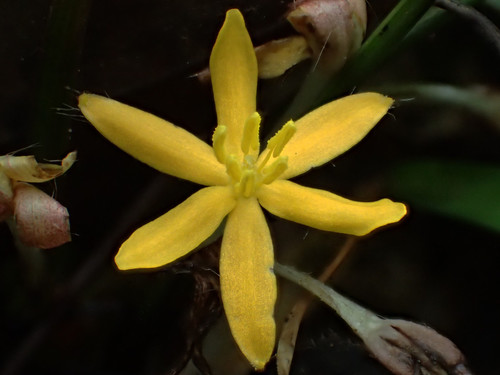
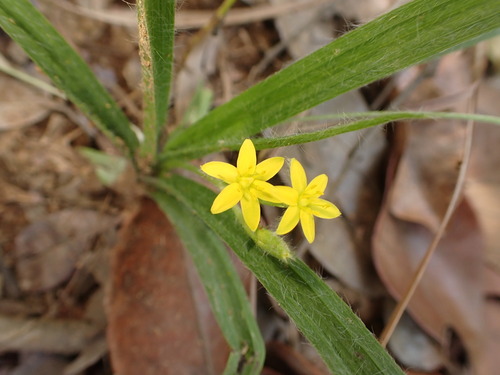
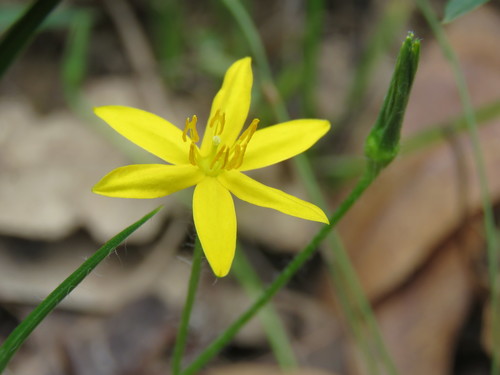
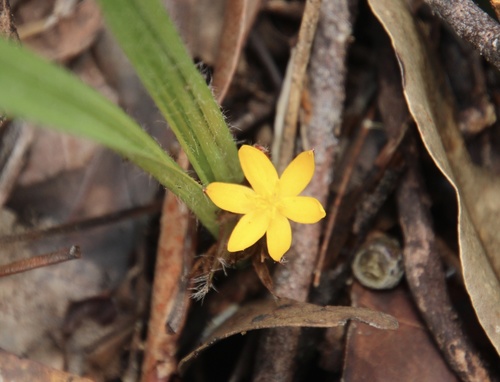
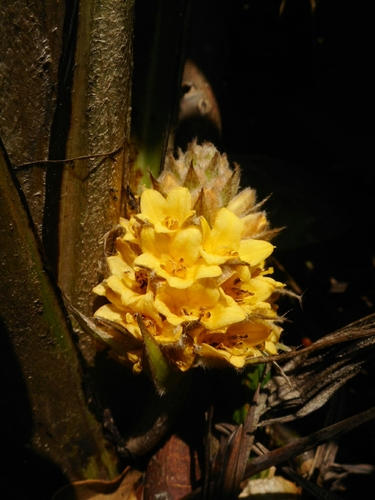
Curculigo capitulata (Lour.) Kuntze, commonly called palm grass for its palm-like foliage, is a tuberous evergreen herb with thick rhizomes and thin stolons. Its rhizomes can remain dormant for long periods in adverse conditions. The plant typically produces 4 to 7 leaves on stalks 30–80 cm long. Leaf blades range from oblong-lanceolate to sublong with pointed tips, have a lengthwise pleated surface, and measure 40–90 cm × 5–14 cm. Inflorescences are hidden among the plant’s leaf bases, concealed by the leaves. Flowering stems are 15–30 cm long and covered in brown hair. Flower racemes are headlike to subovoid, 2.5–5 cm long, and densely packed with flowers. Bracts are lanceolate, 1.5–2.5 cm long, brown and green, and covered in hair. Flowers measure approximately 23 to 25 mm across from petal tip to petal tip, borne on 7 mm long flowering stalks, and are yellow with blunt tips and hairy outer petals. Flower number varies by location: in Bangladesh, most plants produce one flower, occasionally 2 to 3 per plant, while in Nepal, each stem can hold many flowers. Each flower usually has 6 oblong ovate petals about 8 mm × 3.5–4 mm. The flowers have a ginger-like sweet scent. Each flower has three sepals with yellow inner surfaces and hairy outer surfaces, plus three yellow petals. The stamens originate separately then join to form a staminal tube around the stigma and style; they are 5–6 mm long, with filaments less than 1 mm long and linear anthers about 5 mm long. The ovary is hairy, the style is longer than the stamens, and the stigma is subcapitate and nearly petaloid in shape. The berries are white, round, 4–5 mm in diameter, sweet when ripe. The seeds are black and irregularly shaped. Fruits are rarely seen on cultivated plants. Curculigo capitulata is native to a range extending from South Asia (India, Indonesia, Sri Lanka, Bangladesh, Nepal) through Southeast Asia to Southern China, Taiwan, the East Himalayas and northern Australia, and also occurs in tropical Africa. It has spread widely across the tropics, where it is naturalized and cultivated. It was intentionally introduced as an ornamental plant and is widely grown in gardens; it is a popular garden plant in Sri Lanka’s lowlands and midlands, and can also be found, though not abundant, in older gardens in Hawaii. It is commonly cultivated in pots in organic loam. Coarse sand and perlite can be added to the soil to improve drainage. This species is easy to grow, as it tolerates a wide range of light conditions. It grows best in fertile, loamy, moist, well-drained soil rich in organic matter. Fertilizer such as Active 8 can be mixed into existing soil at a 1:1 ratio, and soil should be well mulched to retain moisture. Harvesting occurs once a week for the first six weeks after planting. Pruning involves removing damaged or yellowed leaves. Frequent watering is required in summer, while winter watering is reduced to allow the upper layer of loam to dry out. Monthly fertilization with a hydro-soluble product containing 1/3 micro-elements is required during spring and summer. The Curculigo genus belongs to the family Hypoxidaceae, whose members are traditionally used to treat diabetes, bleeding, and viral infections. In modern use, Curculigo capitulata is mainly cultivated as an ornamental. Historically, it has been used in Indonesia to wrap fruits, vegetables and other food during transportation. The papery texture of its leaves means the plant is rich in fiber, which has many uses for Southeast Asian people. Fibers harvested from the leaves are used to make fishing nets and ropes. The Luha people of northern Thailand use these leaf fibers as wrapping material. Hill people of Camarine, Luzon, Philippines use the fibers to make false hair, and also use the fiber as warp for children’s toy looms. Its fruits are edible and can be added to the daily diet. Its leaves can be made into leaf bandages to cover wounds. Curculigo capitulata has a long history of medicinal use across Southeast Asia. It is widely used in traditional Chinese and Indian medicine to treat severe chronic disease, rheumatic arthritis, nephritis, urinary tract infection, colic, asthma, jaundice, spermatorrhoea, consumptive cough, impotence, kidney anemia, hemorrhoids, diarrhea, and gonorrhea. It is also used in traditional Dai medicine to treat urinary tract infection, acute renal pelvis and phrenitis, nephritic edema, cystitis, nephrolithiasis, hypertension, and rheumatic arthritis. It is also used in veterinary medicine and for land conservation. Its rhizomes are used in traditional medicine to treat eye infections and gastric disorders. The species shows high antioxidant, cytotoxic, thrombolytic, anti-inflammatory and analgesic activities, suggesting potential for use in treating several chronic diseases. It has a strong reduction capacity (absorbance of 1.87 at 400μg/mL), indicating strong antioxidant activity. Its plant extract also inhibits protein denaturation at 500 μg/mL, indicating an ability to prevent blood clotting. The plant has been found to contain high levels of phenols (48.67 mg/g) and flavonoids (24 mg/g). Phenols are commonly used in skin care for their antimicrobial, anti-inflammatory and antiaging activities, so this high phenol concentration suggests potential use of C. capitulata extract in skin care products. A recent experiment found that the species’ roots have antifungal activity against Fusarium oxysporum f. sp. cubense (Foc) tropical race 4 (Foc TR4), the main pathogen that causes fusarium wilt in bananas, meaning C. capitulata extracts have potential to treat this infectious banana disease. Additionally, essential oil extracted from the species’ fruit has been found to have antibacterial and antifungal activities, so further research may reveal more applications for the plant. As an ornamental, it can be used as massed border plantings and as ground cover at the base of large trees, since it tolerates shaded conditions. It requires little maintenance and tolerates a wide range of temperatures.