About Cupressus guadalupensis S.Watson
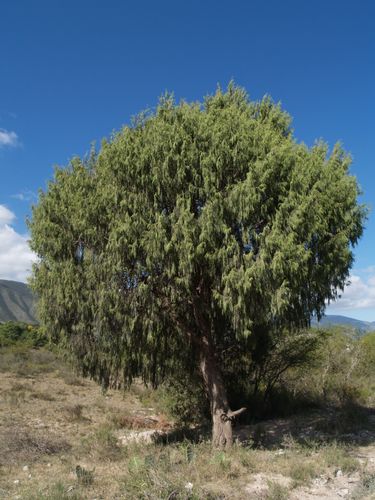
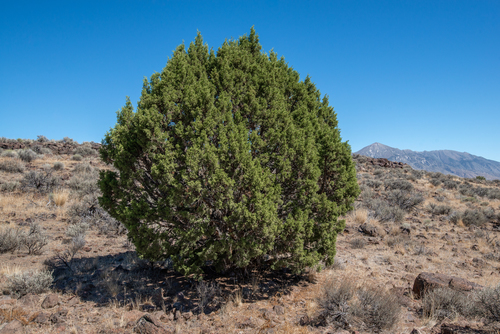
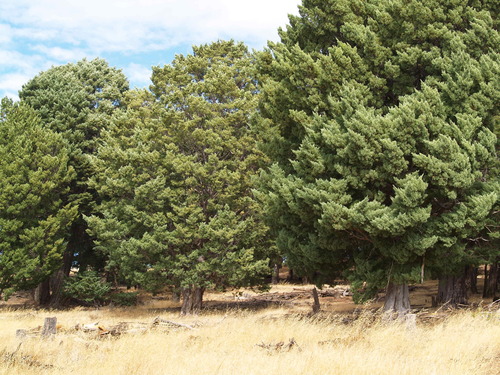
Cupressus guadalupensis S.Watson, commonly known as Guadalupe cypress, is a coniferous evergreen tree. Fully mature individuals develop a broad, dome-shaped crown, and the species varies widely in mature size. Mature trees typically reach 12 to 20 metres (39 to 66 ft) tall; in their native 2000s habitat, most fall towards the lower end of this height range. The first formal scientific description recorded the species growing to 40 feet high or more.
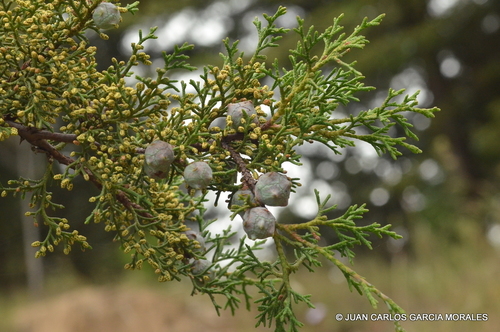
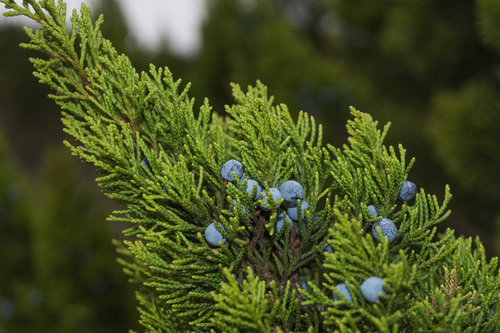
The tree has fairly smooth bark that sheds in thin layers from the trunk, with color ranging from cherry-red to dull gray-brown. Larger branches share the same texture and bark color as the trunk. First-year new shoots are yellow-green to brown. Foliage grows in dense sprays, colored dark blue-green or glaucous blue. Leaves are scale-like, 1.5 to 2 millimeters long, arranged in four rows on rounded (not flattened) shoots. Foliage has a soft texture, and releases a light resinous aroma when crushed. Leaf scales do not shed individually from branchlets; instead, entire small twigs are shed after two to three years. Terminal branchlets reach 2 to 3 centimeters long, and are only 1 millimeter thick.
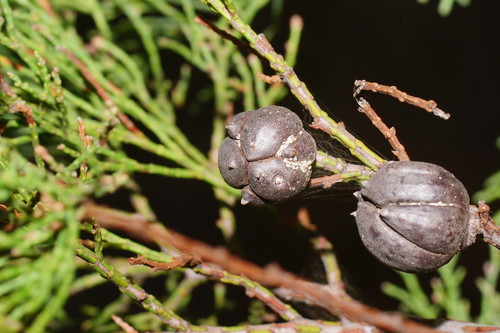
Seed cones of this species are nearly spherical, with 8 to 10 horn-shaped scales that are narrow at the base, wide at the top, and end in a pointed tip. Cones measure 3 to 3.5 centimeters in diameter. They are green while growing, and ripen to gray-brown or brown. Each cone holds approximately 70 to 100 brown seeds covered in a light waxy, glaucous coating. Guadalupe cypress seeds are much larger than those of other western cypress trees, weighing two to seven times as much. Ripe closed cones still attached to trees open after exposure to fire heat; unlike cones of the related Tecate cypress (Hesperocyparis forbesii), these cones also open after several months of drying on the tree without requiring fire exposure. Individual seeds are about 5 to 6 millimeters long, with a small 1-millimeter wing structure. Cones and seeds reach full ripeness 15 to 18 months after fertilization.
Pollen-producing cones, called strobili, have 14 to 18 scales. This trait is used by botanists to distinguish Guadalupe cypress from Tecate cypress, whose pollen cones only have 10 to 14 scales. Guadalupe cypress strobili are relatively large: about 6 millimeters long and 2 to 5 millimeters in diameter. Pollen production occurs from October to November for trees growing in California; for cultivated trees in France and Italy, pollen production has been observed from December to March.
Tree lifespan is estimated by counting annual growth rings in dead tree trunks. This method estimates an average lifespan of 150 to 160 years for a tree with a 50 centimeter trunk diameter. One 64-centimeter diameter trunk collected by botanical explorer Edward Palmer had 236 growth rings, indicating a 236-year lifespan.
Seedlings are very similar to those of all other western cypress species, producing three to five long, thin, needle-like seed leaves that start upright then spread outward from the stem. Each seed leaf is usually 8 to 12 millimeters long. Juvenile leaves resemble the needle-like seed leaves, but are shorter, thinner, and less fleshy in texture. Young trees begin producing adult foliage instead of additional juvenile leaves in their second to fourth year of growth. Under favorable growing conditions, one-year-old young trees reach an average height of 40 to 45 centimeters. By the end of their second year, they reach 110 centimeters. This rapid growth continues, with young trees reaching an estimated 9.7 meters tall in their first decade.
Guadalupe cypress (also classified as Hesperocyparis guadalupensis) is endemic to Mexico, where it occurs naturally only on Guadalupe Island, a Pacific island west of Baja California. It grows at altitudes of 800 to 1,300 metres (2,600 to 4,300 ft). In the 21st century, Guadalupe cypress forms the largest tree community on the island, and is restricted to the island's northwest high plateau. Guadalupe Island is volcanic in origin. Its climate is shaped by cold Pacific Ocean currents, creating conditions similar to mainland regions much farther north. Summers are warm to hot, while winters often bring fog. Fine cypress twigs trap airborne moisture, which drops to the ground or runs down trunks, making the area immediately under the trees wetter than areas without tall vegetation. Winter high winds buffet the island, but dense historic cypress groves created sheltered, calm conditions within their stands.
The introduction of goats to Guadalupe Island drastically impacted the island's entire plant community, including Guadalupe cypress. The exact date of goat release is unknown, but goats were first documented on the island in 1859. Before goat introduction, the estimated Guadalupe cypress population was around 75,000 trees. In 1885, botanist Edward Lee Greene noted that while northern Guadalupe Island showed evidence of an extensive cypress forest, only dead and fallen trees remained at that site. A smaller grove on the island's east side also disappeared sometime after the 1920s. Available evidence also indicates fire frequency has increased on the island. Though Guadalupe cypress is partially adapted to fire, more frequent fires are likely an additional cause of early tree mortality.
Along with Guadalupe palm (Brahea edulis) and Guadalupe pine (Pinus radiata var. binata), Guadalupe cypress is one of the dominant, defining plant species on Guadalupe Island, and acts as an ecological keystone. A 1950s study of the island's bird life recorded the Guadalupe Island subspecies of ruby-crowned kinglet (Corthylio calendula obscurus) frequently using Guadalupe cypress groves. The endemic Guadalupe Island subspecies of house finch, Haemorhous mexicanus amplus, was also very common in these groves.
While endangered in its wild habitat, Guadalupe cypress has a long history of cultivation in California and other regions around the world. It was being grown in the San Francisco area before 1878, though the exact introduction date is unknown. Despite this long history of use in gardens and parks, it is not a commonly cultivated species in the United States. Scientist William Dallimore reported that Guadalupe cypress seldom produces cones in cultivation, and similar reports persist. However, cultivated trees in Italy and France do produce seed crops, and the species is most often propagated from seed. It can also be grown successfully from cuttings and grafting, including grafting onto Cupressus sempervirens or Hesperocyparis glabra. It is a much more popular and common ornamental species in Europe than in North America.
Guadalupe cypress has very low frost tolerance, and is particularly noted for sensitivity to spring frosts. It is generally restricted to USDA Zone 9 or warmer, requiring a minimum low temperature between −6.5 and −1 °C (20 and 30 °F). The narrow fastigiate (columnar) cultivar 'Greenlee's Blue Rocket' is reported to tolerate temperatures as low as −9.5 °C (15 °F). The species is especially well suited to coastal plantings, as it resists damage from coastal spray and wind. It is also highly adaptable to a wide range of soil conditions. Unlike Monterey cypress, it is highly resistant to cypress canker; there is only one documented report of infection in scientific literature. In Europe, it sometimes shows infestation signs from cypress bark beetles (Phloeosinus) in its crown.
There are no significant commercial plantations of Guadalupe cypress, and it has no widespread uses within its native habitat. The largest known individual grows in a park in Fresno, California, reaching 21 m (69 ft) in height with a trunk diameter at breast height of 1.63 m (5.3 ft).