About Cupitha purreea (Moore, 1877)
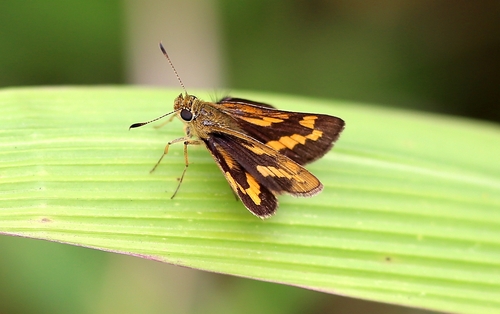
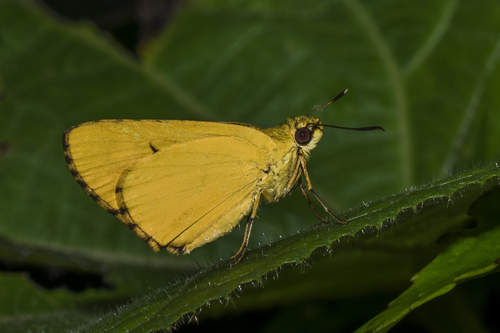
Cupitha purreea (Moore, 1877) has the following physical description. On the upperside, the base color is blackish-brown. Cilia are yellow, slightly alternating with black. The forewing bears a gamboge-yellow basal streak, and an oblique irregular median band that starts near the apex, extends to the hindmargin, and ends at its base. The hindwing has a short median yellow band. On the underside, the base color is sulphur-yellow. The forewing has a broad dark brown basal streak, a small spot at the end of the cell, and a large patch at the posterior angle. The hindwing has a brown-speckled streak along the inner margin that ends broadly at the anal angle. The upper surface of the body is brown; the head and thorax are interspersed with yellow hairs. The abdomen has narrow yellow bands. Palpi are black on the upper side and yellow on the lower side. The legs and underside of the body are yellow. Females are larger than males. In females, yellow color runs fully through the discal basal area of the posterior wings, and only extends through the interno-median area of the anterior wings. The yellow sections of the cilia, especially toward the inner and anal angles, are darker and lean toward orange. Mr. de Niceville recorded that males have a bare patch at the end of the cell on the upperside of the hindwing, which holds an oval patch of closely packed scales. Cupitha purreea is distributed across the range from southern India and Sikkim to Burma, southern Yunnan, the Andamans, Thailand, Laos, Langkawi, Malaysia, Tioman, Borneo, Sumatra, Nias, Java, the Philippines and Sulawesi.