About Cuphophyllus virgineus (Wulfen) Kovalenko
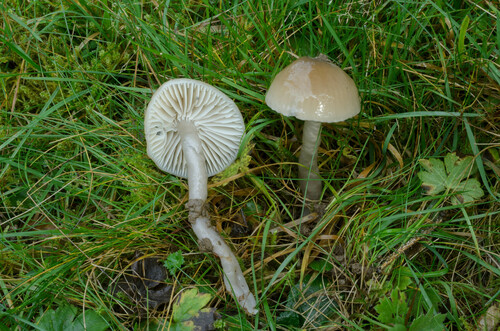
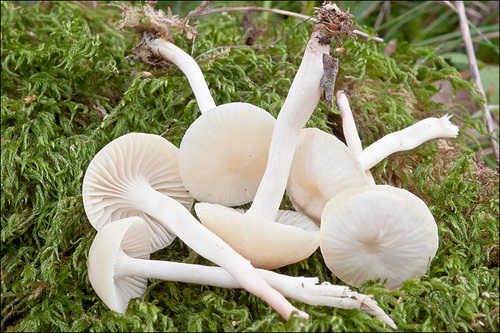
Cuphophyllus virgineus produces agaricoid basidiocarps. Its cap is convex when young, becoming flat or slightly depressed as it expands, reaching up to 7.5 centimetres (3 in) across. The cap surface is smooth, waxy when damp, hygrophanous and somewhat translucent with a striate margin; it is typically white to ivory, rarely with ochre to brownish tints. The lamellae (gills) are waxy, the same colour as the cap, and decurrent, meaning they are widely attached to and run down the stipe. The stipe (stem) is up to 7 cm long, smooth, cylindrical or tapering towards the base, matches the cap's colour, and is waxy when damp. The flesh is white, with a mild smell and a bitter to acrid flavour. The spore print is white; under a microscope, spores are smooth, inamyloid, and ellipsoid, measuring about 7.0 to 8.5 by 4.5 to 5.0 μm. This species is sometimes parasitized by the mould Marquandomyces marquandi, which turns the lamellae violet. This species, commonly called the snowy waxcap, is widespread across the north temperate zone, and is found in Europe, northern Asia, North America, and Australia. Like other waxcaps, in Europe it grows in old, unimproved, short-sward grassland including pastures and lawns, but it grows in woodland in other regions. Recent research indicates that waxcaps are neither mycorrhizal nor saprotrophic, but may be associated with mosses.