About Cuphophyllus lacmus (Schumach.) Bon
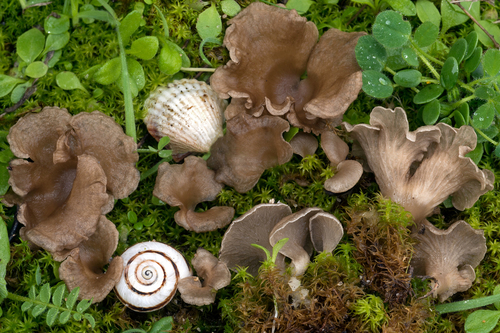
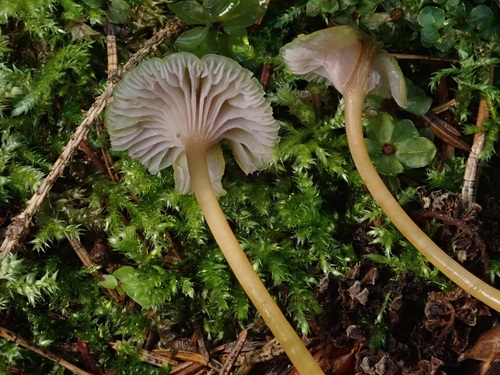
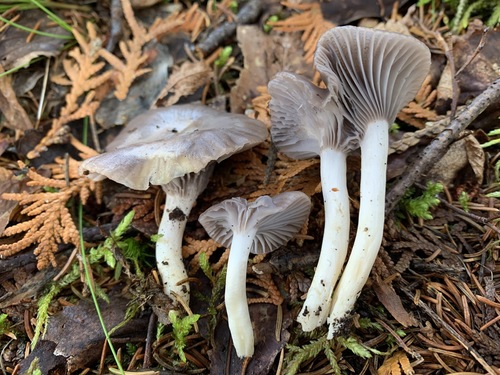
Cuphophyllus lacmus (Schumach.) Bon produces agaricoid basidiocarps that grow up to 70 mm (5 in) tall. The cap is hemispherical when young, expanding to become broadly convex to flat, and reaches up to 60 mm (3 in) across. The cap surface is smooth, slightly greasy when damp, and colored grey to bluish grey. Its gills (lamellae) are waxy, thick, and decurrent (running down the stem), with a color ranging from pale to dark grey. The stipe (stem) is smooth, white, and lacks a ring. This species produces a white spore print; under a microscope, the spores are smooth, inamyloid, and ellipsoid, measuring approximately 7 to 8 by 4.5 to 6 μm. Commonly called the Grey Waxcap, this fungus is widespread but generally rare across Europe, and is also found in Greenland. Like most other European waxcaps, Cuphophyllus lacmus grows in old, agriculturally unimproved, short-sward grassland such as pastures and lawns. Recent research indicates that waxcaps are neither mycorrhizal nor saprotrophic, and may be associated with mosses.