About Cupaniopsis anacardioides (A.Rich.) Radlk.
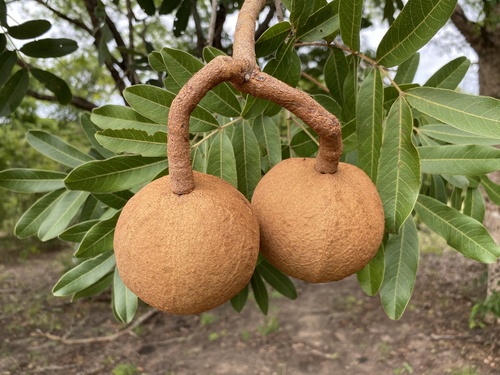
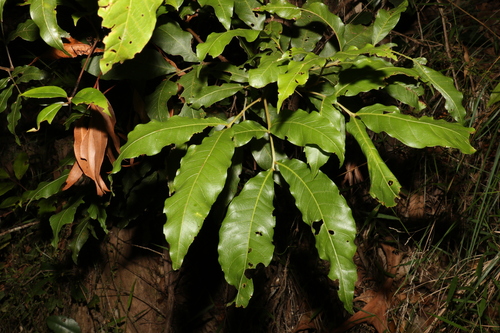
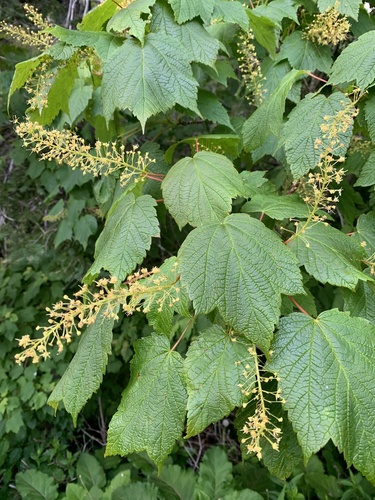
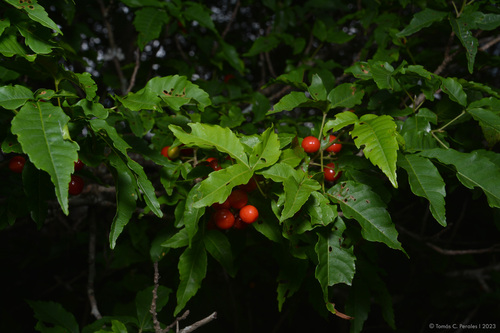
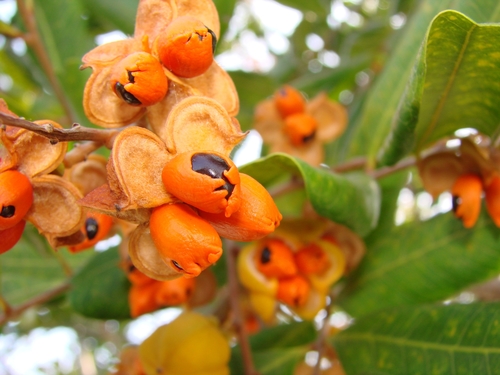
Cupaniopsis anacardioides (A.Rich.) Radlk. is a tree that typically reaches a maximum height of 11 m (36 ft), with a diameter at breast height of up to 50 cm (20 in). Its branchlets are lenticellate, and sometimes covered with short hairs that lie pressed against the surface. The leaves are paripinnate, measuring 150–250 mm (5.9–9.8 in) in length, and bear 4 to 8, sometimes up to 12 leaflets. The leaflets are elliptic or egg-shaped, with the narrower end oriented toward the base. They measure 45–190 mm (1.8–7.5 in) long and 16–75 mm (0.63–2.95 in) wide, and grow on a petiolule 2–7 mm (0.079–0.276 in) long. Leaflets have a leathery texture with prominent veins, and their lower surface is sometimes covered with soft hairs. Separate male and female flowers are produced in panicles 80–350 mm (3.1–13.8 in) long, which grow from a softly-hairy peduncle. The flowers are greenish-white or yellowish, and borne on a pedicel 3–7 mm (0.12–0.28 in) long. The sepal lobes are 2.5–4.0 mm (0.098–0.157 in) long, and the petals are egg-shaped, 1.5–3 mm (0.059–0.118 in) long. Flowering takes place in June and July, and the fruit is a golden yellow capsule with a red tinge.
This species most commonly grows on rocky beaches, in hilly scrub, and in littoral rainforest on sand or near estuaries. It is naturally found in New Guinea, the Dampierland and Northern Kimberley bioregions of northern Western Australia, the far north of the Northern Territory, and in Queensland and New South Wales, Australia, ranging as far south as Gerroa. It has been introduced to Pakistan, Florida, and Hawaii, and is classified as an invasive species in the United States.
The fruit of this species, commonly called tuckeroo, attracts many bird species including the Australasian figbird, olive-backed oriole, and pied currawong. It also serves as a food source for the larval stages of several butterfly species: Anthene lycaenoides, A. seltuttus, and Arhopala micale.
In horticulture, tuckeroo germinates easily from fresh seed, especially when the seed is removed from the aril and soaked for a few days. It is widely cultivated in parks, and makes a spreading, shady street tree.