About Culaea inconstans (Kirtland, 1840)
Body and Fin Structure
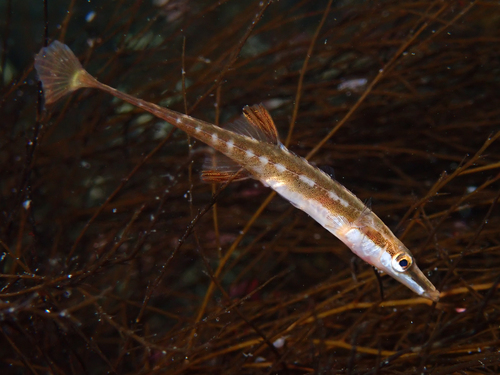
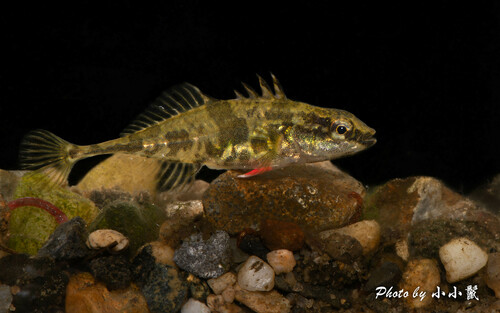
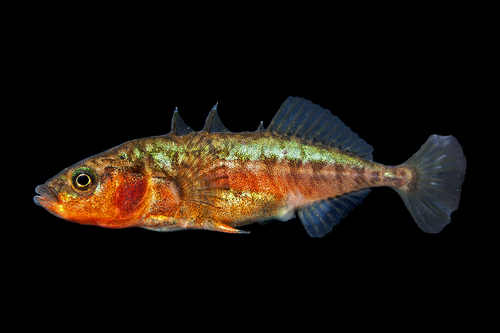
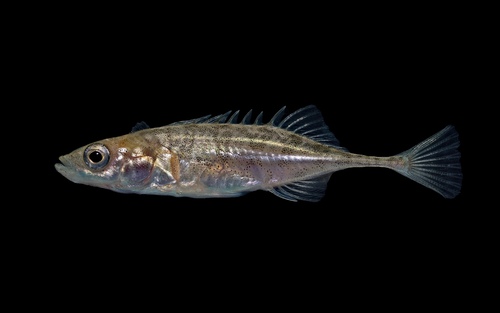
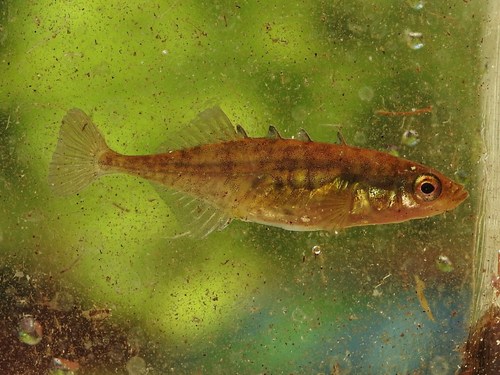
The brook stickleback (Culaea inconstans) has a tapered body, a slim caudal peduncle, and a fan-shaped tail. It strongly resembles the ninespine stickleback (Pungitius pungitius), but only has five, or occasionally six, dorsal spines, and it also lacks lateral bony plates.
Non-Spawning Coloration
For most of the year, its color is grayish or olive green with varying amounts of indistinct mottling.
Spawning Season Coloration
During the spawning season, males turn nearly black, while females develop darker and lighter patches.
Size
This species reaches a maximum length of 3 to 5 cm (1.2 to 2.0 in), making it one of the smallest fish species in its native region.
Core Native Distribution
Culaea inconstans is native throughout the southern half of Canada and the northern part of the eastern United States, ranging south into the southern portions of the Mississippi River and Great Lakes drainage basins. Native populations also exist as far west as Colorado and Nebraska, and as far north as Alberta, Saskatchewan, Manitoba, and the Northwest Territories.
Brackish Water Occurrence
Brackish water populations are uncommon but do occur.
Nebraska Distribution
In Nebraska, brook stickleback populations have been recorded since the early 1900s, and they are generally found in small streams in the northern part of the state. The species sustains populations in the Loup, Middle Platte, and Niobrara river drainages, with smaller populations in the Lower Platte, Missouri River tributaries, North Platte, and South Platte drainages.
New Mexico Native Populations
Some distribution studies have found that certain populations in New Mexico may be native and still persist today.
Introduced Range
Outside its typical native range, the species has been introduced to Alabama, Kentucky, Tennessee, northwestern Colorado, Wyoming, northeastern Utah, California, parts of South Dakota, and parts of Washington State.
Conservation Status
Despite its extensive distribution across North America, the Nature Conservancy has ranked this species as S3, or vulnerable.
Vulnerability Driver
The vulnerability is likely tied to increased dam construction, especially in the eastern United States.
Dam Construction Impacts
Dam construction destroys habitat, increases siltation in waterways, alters stream nutrient transport, and damages breeding grounds. Changes to stream dynamics can also alter predator occurrence, exposing brook sticklebacks to new, unexpected predators.
General Habitat Types
Brook sticklebacks occupy a wide range of flowing water habitats across their large geographic range, including rivers, streams, floodwater streams, drainages, lakes, ponds, potholes, hot springs, sinkholes, and seasonal meltwater or spring-fed ponds.
Spawning and Rearing Habitat
Their primary spawning, breeding, and rearing grounds are shallow (less than 1.5m deep) near-shore environments with dense vegetation cover and low water velocity.
Elevation Range
The species has a broad elevation range, with specimens recorded from sea level up to approximately 2,400 m.