About Cucumis prophetarum L.
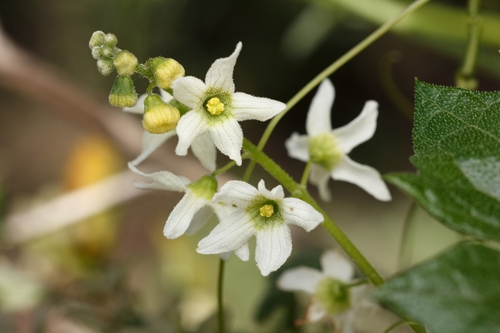
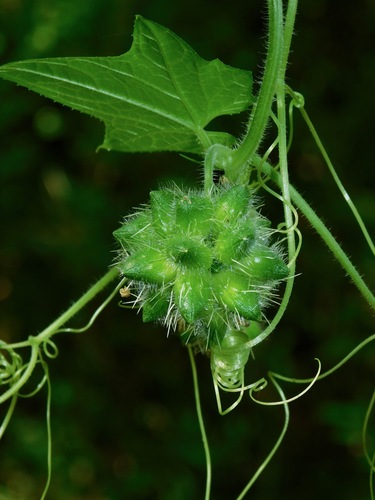
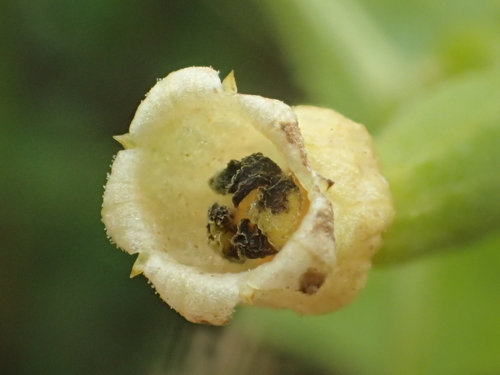
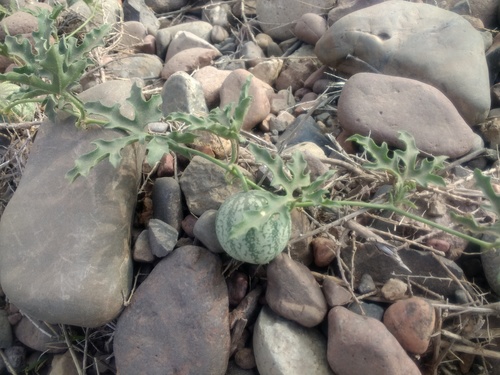
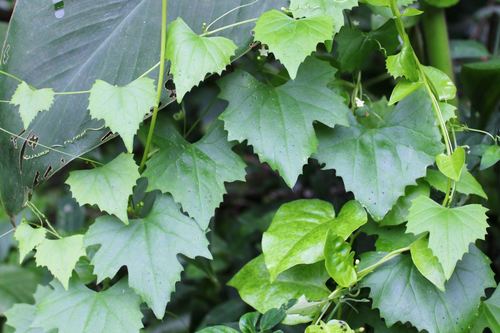
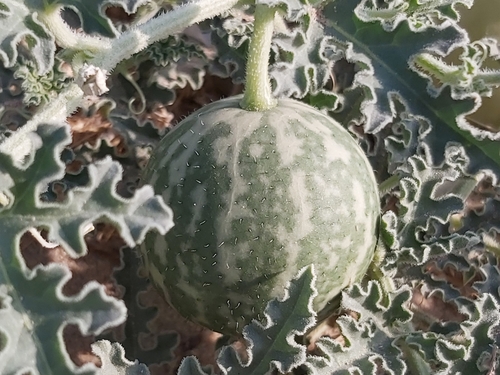
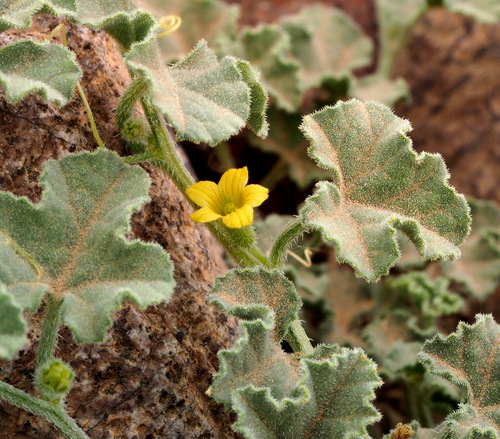
Cucumis prophetarum L. has hairy stems and leaves. Its leaves are ovate to round in shape, with a cordate base, and measure 2–4 centimeters in length. Leaf margins are dentate or lobulate, bearing 3–5 lobes that have blunt teeth, and can be obtuse or subacute. Leaf petioles are 6–87 millimeters (0.24–3.43 inches) long. Male flowers grow in clusters of 2–3 on 3–25 millimeter (0.12–0.98 inch) long pedicels, and are rarely solitary. Female flowers are always solitary, with 6–30 millimeter (0.24–1.18 inch) long peduncles. Flowers have five yellow petals that are 5–8 millimeters long and 2.5–3.5 millimeters wide. Ripe fruit is slightly ovoid, vertically striped, yellow, 3–4 centimeters long, and covered in spike-like pustules. This species is native to Africa and the Middle East. In Africa, its native range extends from Mauritania east to the Horn of Africa, southwest to Angola, and southeast to South Africa. In the Middle East and South Asia, it is native from Israel south to Yemen and Oman, and east to northwestern India. It has been introduced to Qatar. It grows wild in semi-desert bushland and grassland at elevations up to 6,594 feet (2,010 meters), and is often found growing alongside acacia trees. Raw fruit of Cucumis prophetarum L. has a bitter flavor, so it is sometimes boiled or pickled. Its leaves are cooked and served with a staple food. The fruit is eaten throughout its native range, it is occasionally cultivated, and it is sold in local markets. In Saudi Arabian folk medicine, the fruit is also used to treat liver disorders.