About Cucumis metuliferus E.Mey. ex Schrad.
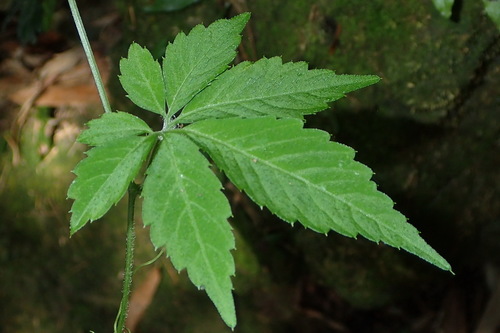
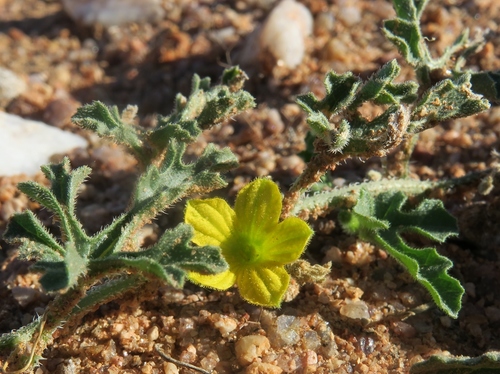
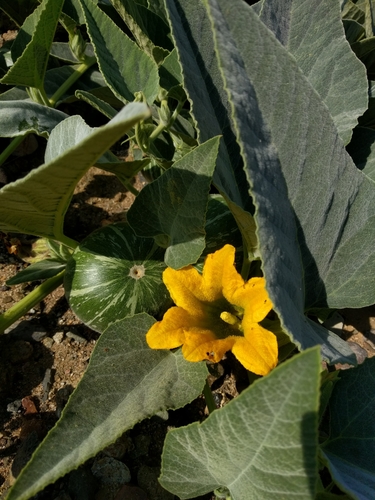
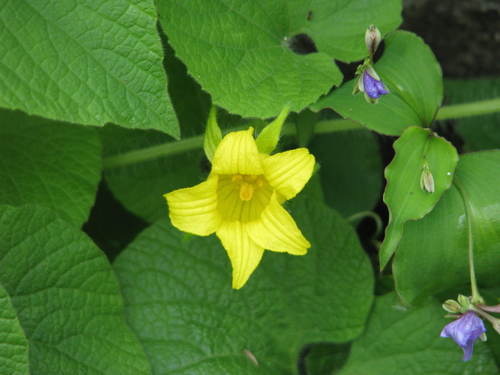
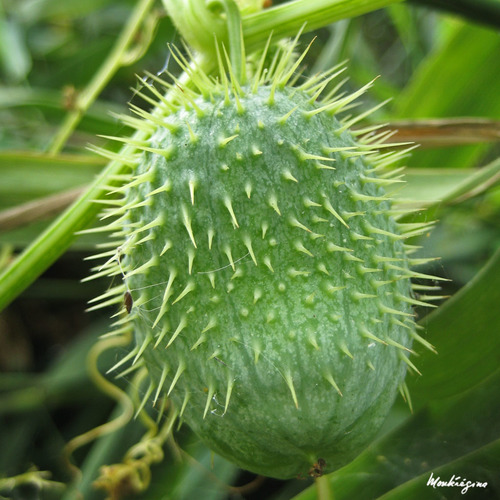
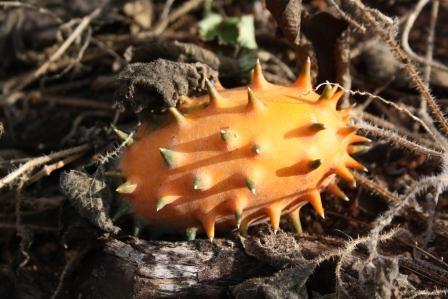
Cucumis metuliferus (scientific name: Cucumis metuliferus E.Mey. ex Schrad.) has multiple common names: African horned cucumber, often shortened to horned cucumber, horned melon, spiked melon, jelly melon, and kiwano. It is an annual vine belonging to Cucurbitaceae, the plant family that includes cucumbers and melons. Its fruit features distinct horn-like spines, which gives the plant its common name 'horned melon'. When ripe, the fruit has orange skin and soft, lime-green flesh. This species is native to Southern Africa, occurring in South Africa, Namibia, Botswana, Zambia, Malawi, Zimbabwe, Mozambique, and Angola. Kiwano is a traditional food plant in Africa. Alongside the gemsbok cucumber (Acanthosicyos naudinianus) and tsamma (citron melon), it is one of the few sources of water during the dry season in the Kalahari Desert. In northern Zimbabwe, it is called gaka or gakachika, and it is primarily eaten as a snack or added to salads, and only rarely used for decoration. It can be consumed at any stage of ripening. Cucumis metuliferus can be grafted as a rootstock for melon, to prevent both reduced growth and heavy nematode buildup in soil infested with M. incognita. The fruit's taste has been described as a combination of banana and passionfruit, a combination of cucumber and zucchini, or a combination of banana, cucumber and lime. However, it is very often almost completely tasteless. Adding a small amount of salt or sugar can improve its flavor, but the fruit's high seed content makes it less convenient to eat than many common fruits. Some people also eat the fruit peel, which is very rich in vitamin C and dietary fiber.