About Cucullia chamomillae (Denis & Schiffermüller), 1775
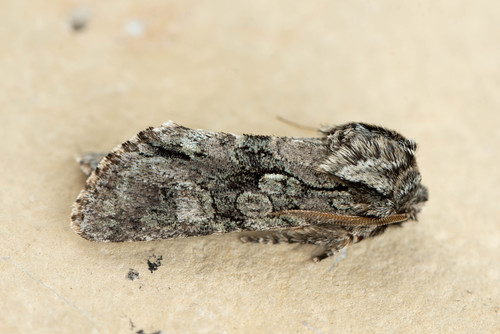
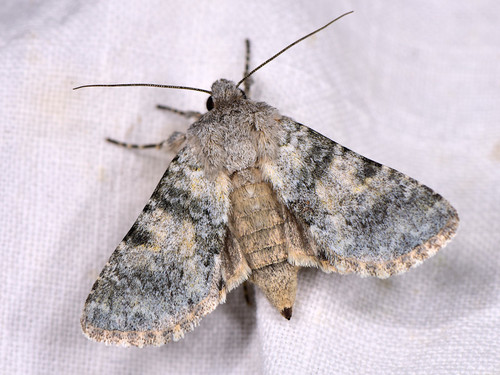
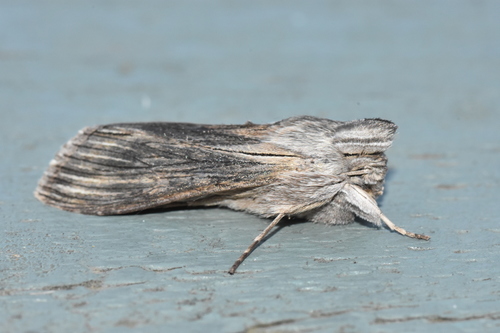
Cucullia chamillae (Denis & Schiffermüller), 1775 has a wingspan of 40–42 mm, with a forewing length of 19–23 mm. The forewing is long and narrow with a produced apex. The abdomen is elongate, especially in males, and bears lengthened anal tufts. The forewing is grey brown, with distinctly black veins. It has a whitish spot on the submedian fold between the angles of the inner and outer lines, which are more distinct in their lower portions. The stigmata are very indistinct, and sometimes marked by black points on their margins. A fine black streak runs from the base along the submedian fold; there is also a black streak above the middle of vein 4, and below the terminal end of vein 2. A row of whitish streaks lies in the subterminal intervals. The hindwing is brown, and paler towards the base, particularly in males. The form chrysanthemi Hbn., found especially in the Alps, northern Germany, and Hungary, has forewings suffused with dark smoky fuscous, especially in the median area, and the hindwing also becomes a deeper brown. The form leucanthemi Rmb. from Andalusia is a yellower form. The related species Cucullia calendulae Tr. has paler grey ground colour and slighter markings. The egg of Cucullia chamomillae is cone-shaped, blunt at the upper end, covered with many ribs, and white with small distinct reddish brown spots. Mature caterpillars occur in different colour morphs. On the back they have wide slashes shaped like a slightly open V, along with clear bowed strokes on the sides. Their basic colour ranges from whitish, cream, greenish, light brown, reddish brown or violet to blackish. The spiracles are bordered with white and black, and the head is dark spotted. The pupa is yellowish brown. Its proboscis sheath is clearly distinct, and the cremaster is flat, slightly curved, and spatula-shaped.