About Cucullia artemisiae (Hufnagel, 1766)
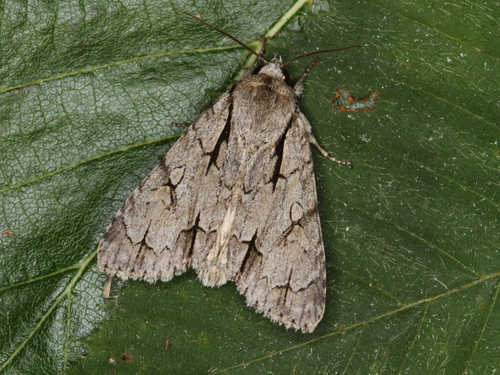
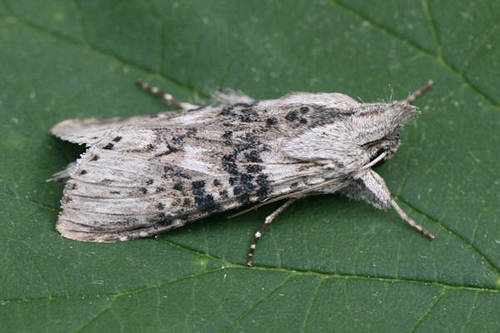
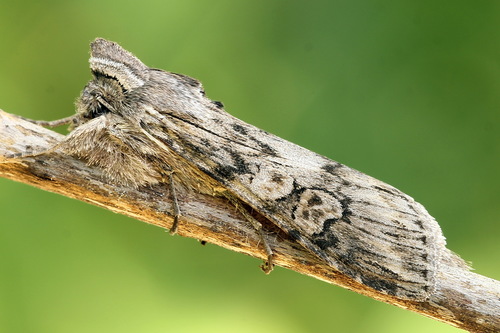
This species is scientifically known as Cucullia artemisiae (Hufnagel, 1766), also referenced as C. artemisiae Hufn. (= abrotani F.). For the forewing: it is grey, with grey-brown suffusion along the costa and along the path of the lines; the lines are double and dark; the inner line is angled outwards between veins and inwards, the outer line is only clear below the middle; veins are finely black; a pale space below the cell represents the claviform stigma, which is sometimes edged above and below by two fine black lines; the orbicular and reniform stigmata are distinct, with brown centers and whitish grey annuli outlined in black; the subterminal line is followed by a diffused row of dentate brownish marks. The hindwing is brownish, and paler towards the base. The previously described form ab. lindei Heyne is now recognized as the full species Cucullia lindei Heyne, 1899; this form, found only in the area around Moscow, is a local variant where the entire forewing is suffused with blackish grey. The larva is green, with darker segmental lines; the dorsal line is fine and white; the lateral stripe is broad, yellow, and somewhat interrupted; spiracles are white and set in black rings; tubercles are red; the head is brown, blackish towards the back, with a pale-edged frontal triangle; the venter is pale green with two fine green lines, which show red-brown coloring on the 3rd and 4th segments. The wingspan of Cucullia artemisiae is 37–42 mm.