About Cryptolepis decidua (Planch. ex Hook.fil. & Benth.) N.E.Br.
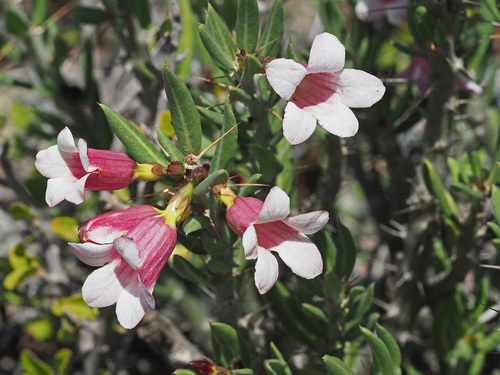
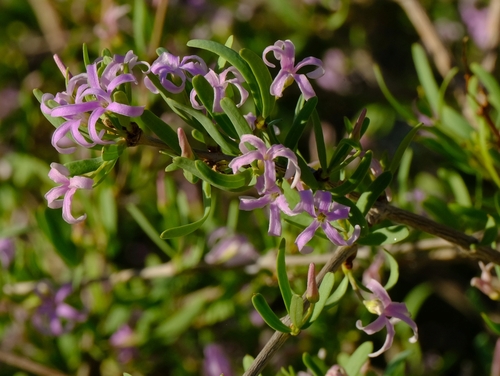
Cryptolepis decidua is a shrub that grows up to 1.5 meters tall. It has straight, slender stems covered in pale grey bark. Its leaves grow in clusters; each leaf is hairless, shaped linearly to slightly spatula-shaped, and measures 1.9–2.5 centimeters long by 0.25–0.5 centimeters wide. Leaf tips are blunt or slightly pointed, and leaf bases end in a rudimentary petiole. When leaves fall, the petioles remain and form overlapping stacks. Solitary flowers grow at the junction between leaves and stems, and may appear in groups of two or more due to the clustered arrangement of leaves. Flowers are borne on pedicels 0.8–1.9 centimeters long, which have slender, hairless bracts located midway along their length. Flower buds are twisted into a spiral. Each flower has 5 lance-shaped sepals, 2.5 millimeters long with pointed tips. The 5 petals are fused at their base to form a 2.5-millimeter-long bell-shaped tube, and their lance-shaped, hairless petal lobes are 7.6 millimeters long. Between the petals and stamens, flowers have a ring-like structure called a corona. The corona has 5 thread-like lobes that are 3.8–5.1 millimeters long and attached halfway up the petal tubes. The stamens have tapering anthers that arch over the stigma. The pistil styles are shorter than the anthers and have cone-shaped tips. This species has been observed growing at elevations up to 2000 meters. In Namibia, its roots are reported to be used as a traditional medicine. Laboratory tests on isolated human blood cells have found that extracts from its tissues have immunomodulatory activity. It has also been included in lists of poisonous plants from South Africa.