About Cryptogramma acrostichoides R.Br. ex Richards.
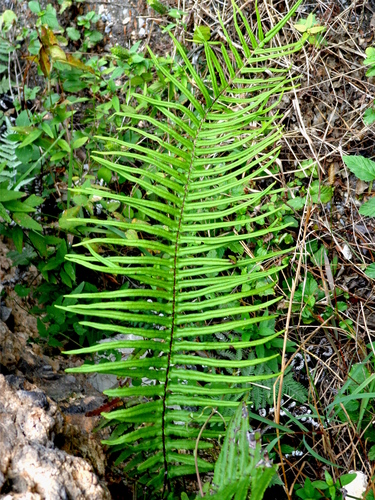
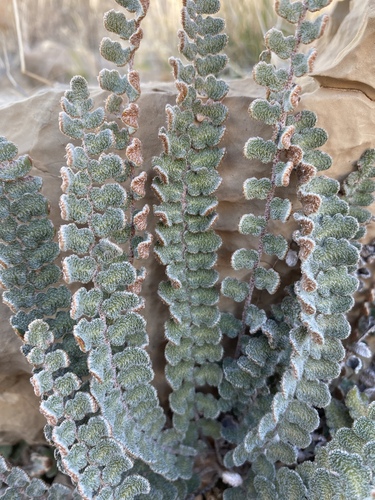
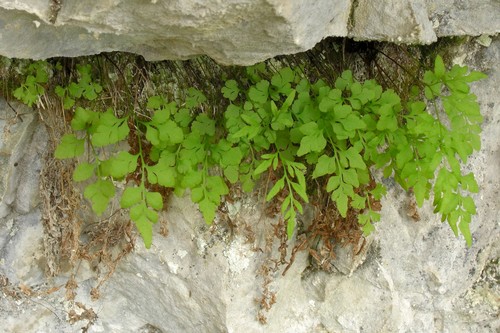
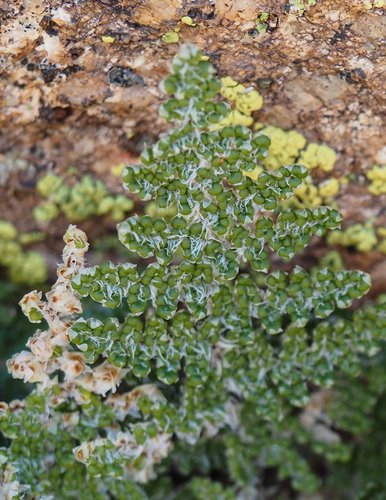
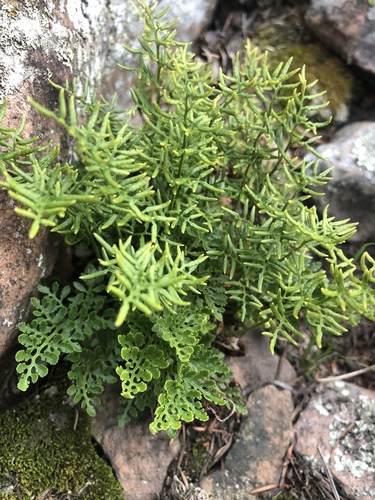
Cryptogramma acrostichoides grows as a single tuft from a short rhizome. This fern produces two distinct types of leaves. Sterile leaves have flat, oval, lobed leaflets that resemble parsley. Fertile leaves are longer, with narrow, thick, linear leaflets; their margins curl under to cover sporangia located on the undersides of the leaflets. Fertile leaves typically stand well above the height of sterile leaves.
Some individuals of this species die back completely by the end of a dry period, while others stay green through winter and die back in spring. In both cases, old leaves are not shed, so they are usually visible as a tuft of dead leaves in the following growing season. This characteristic distinguishes the species from its close relative Cryptogramma cascadensis, which is fully deciduous. At the end of each vein near the leaflet edge, hydathodes form a pit-like depression; in contrast, the hydathodes of Cryptogramma cascadensis are shallower, long, and narrow. Sparse short appressed hairs grow in the groove on the upper side of the rachis and costae; these hairs are difficult to see without close inspection with a lens.
This species is found mostly in the coastal mountain ranges of western North America and in the Rocky Mountains. In coastal mountain systems including the Cascade Mountains and Sierra Nevada, its range extends from Alaska to California. In the Rocky Mountains, it occurs from southeastern British Columbia through New Mexico.