About Cryptocarya foveolata C.T.White & Francis
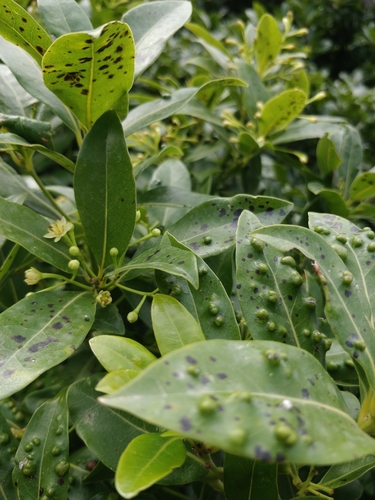
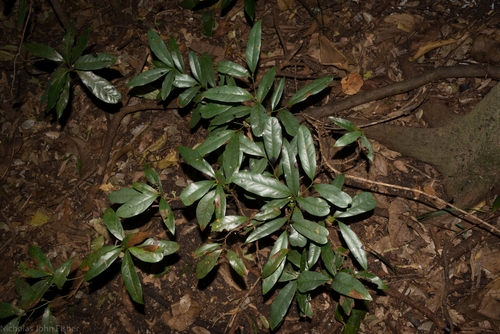
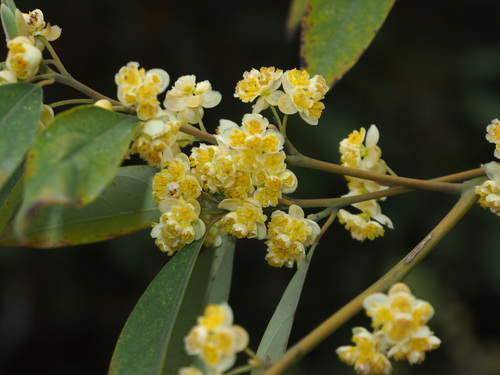
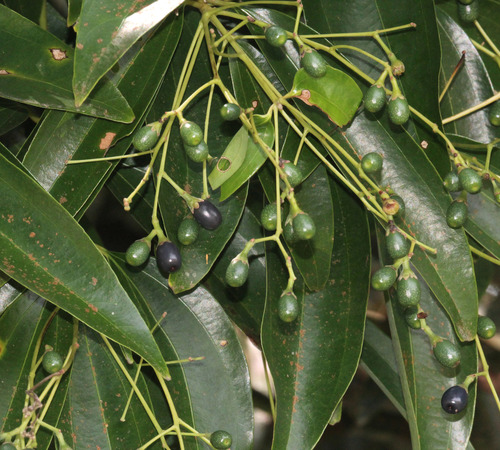
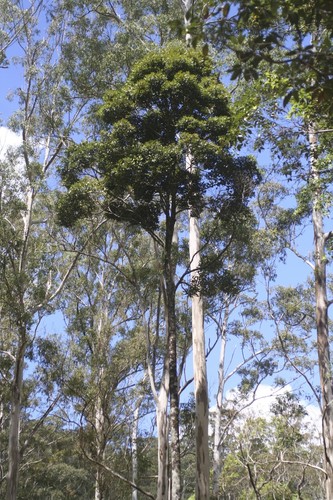
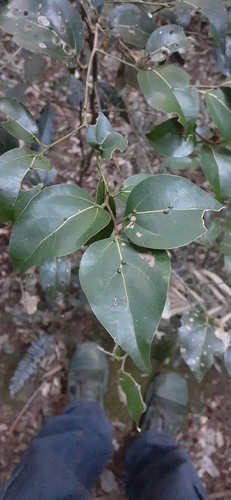
Cryptocarya foveolata C.T.White & Francis is a medium-sized to large tree, usually reaching 40 meters (130 feet) in height, with a trunk diameter at breast height of up to 120 centimeters (47 inches). Its stem is sometimes buttressed. The bark is brown, mostly smooth, with vertical lines of small bumps running along the trunk. Leaves are alternately arranged, elliptic to egg-shaped. They measure 35–70 mm (1.4–2.8 in) in length and 20–36 mm (0.79–1.42 in) in width, and grow from a petiole 4–7 mm (0.16–0.28 in) long. Leaves usually have 3 distinct veins; they are green on the upper surface, more or less glaucous on the lower surface, and have many small pits across their surfaces. One or two pairs of hollow leaf glands called domatia are present at the base of the leaf. The flowers are cream-colored, scented, and arranged in panicles or racemes located in leaf axils; these flower clusters are shorter than the leaves. The perianth tube is 1.5–1.6 mm (0.059–0.063 in) long and 1.6–1.8 mm (0.063–0.071 in) wide, and is covered in soft hairs. Tepals are 1.9–2.5 mm (0.075–0.098 in) long and 1.0–1.5 mm (0.039–0.059 in) wide. Outer anthers are 0.9–1.1 mm (0.035–0.043 in) long and 0.6–0.8 mm (0.024–0.031 in) wide, while inner anthers are about 1 mm (0.039 in) long and 0.6–0.7 mm (0.024–0.028 in) wide. The ovary is 1.0–1.1 mm (0.039–0.043 in) long and 0.6 mm (0.024 in) wide, and the style is hairless. Flowering occurs mainly in November and December. The fruit is a spherical black drupe, 13–14 mm (0.51–0.55 in) long and 15–16 mm (0.59–0.63 in) wide. This species grows in rainforests on fertile soils, most often at elevations of 600 m (2,000 ft) or higher above sea level. It is commonly found growing alongside Antarctic beech. Its natural distribution ranges from Mount Royal in the Barrington Tops to the McPherson Range on the border of Queensland and New South Wales.