About Crupina vulgaris (Pers.) Cass.
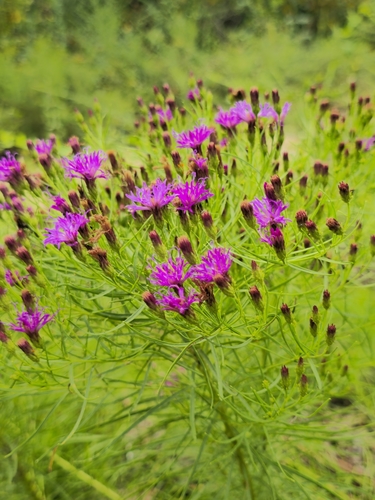
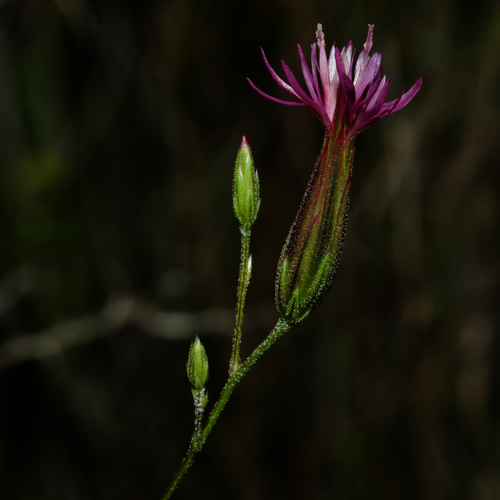
Crupina vulgaris (Pers.) Cass. is a species of flowering plant in the family Asteraceae. Its common names are common crupina, bearded-creeper, false saw-wort, and starry scabious. It is native to parts of Europe, Asia, and North Africa, and is an introduced, often noxious weed in other regions. This winter annual herb grows a slender, ridged stem that reaches roughly 120 cm (4 feet) tall; the stem is branched and leafy toward its base. Basal leaves can be entire, toothed, or divided, with rough-haired surfaces and bristly edges, and they usually wither by the time the plant flowers. Leaves growing higher on the stem are up to 3.5 centimeters long, divided into narrow lobes with bristly edges. Slender flower heads measure roughly 1 or 2 centimeters long, and each holds up to 5 florets, with usually only one fertile floret. All florets have a purple corolla. The plant produces one large fruit, a cypsela, that can be up to 1.6 centimeters long when counting its barrel-shaped main body and long, spreading pappus made of brown or black bristles. This fruit can weigh up to 36 milligrams, and an average plant produces around 130 fruits. After the seeds ripen, flower heads often detach from the plant; each head typically holds one fruit, or occasionally two if it developed two fertile florets. Seeds fall out and are dispersed by wind or on the feet of livestock. They travel longer distances when floating on water, or when transported by rodents, birds, or humans, including on farm machinery and in contaminated shipments of hay or grain. Seeds can pass unharmed through the digestive tracts of most animals, with the exception of sheep. Seedling cotyledons have a bright purple-red or purplish-red midvein and margins. This plant can tolerate a wide range of temperatures, moisture levels, and soil types, and grows in many habitat types including fields, pastures, grasslands, roadsides, railroads, and dump sites. It is not invasive within its native range, but in naturalized regions such as the rangelands of the western United States, it can harm native flora through competition, reduce forage quality, and increase soil erosion. It can form dense, wide stands in open fields. It is unpalatable to most grazing animals, which avoid it and selectively eat other grasses and herbs, letting this weed survive and spread. While sheep and goats do eat the plant, they are not effective for eradicating it. A number of natural enemies of Crupina vulgaris have been recorded: the mite Aceria balasi attacks its inflorescence; the moths Clytie illunaris, Metzneria aprilella, and Ornativalva plutelliformis feed on its seeds; the weevil Styphlus penicillus feeds on its leaves; and Ramularia crupinae, a pathogenic sac fungus first described from this plant, grows on its leaves. No biological pest control agents for this weed have been established to date.