About Crossoptilon crossoptilon (Hodgson, 1838)
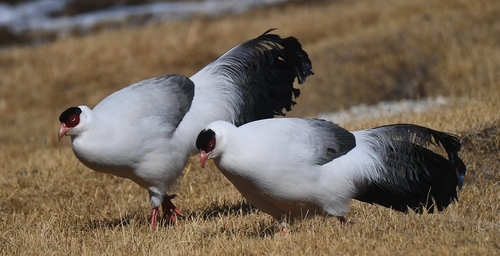
The white eared pheasant, scientifically named Crossoptilon crossoptilon, is also commonly called Dolan's eared pheasant or Bee's pheasant. It is a species of eared pheasant, getting its name from its white overall coloration and the prominent ear tufts that characterize its genus – the name does not refer to having white ears. Indigenous Himalayan people call this species shagga, which translates to snow fowl. This is a gregarious bird that lives in large flocks, and it forages year-round on alpine meadows located near or above the snowline. C. crossoptilon is found in China, across the regions of Qinghai, Sichuan, Yunnan, and Tibet. In this range, it typically inhabits mixed forests, and it is often found around Buddhist monasteries. Also called Szechuan white eared pheasant, this species does not mate until individuals reach two years old. Breeding begins in a heated active period around the end of April, and continues through June. Clutches usually contain four to seven eggs, and eggs have an incubation period of 24 to 25 days. There is minimal sexual dimorphism between male and female Szechuan white eared pheasants, though cocks are noticeably larger than hens. The species reaches a total length of 86 to 96 cm. Females weigh 1400 to 2050 g, while males weigh 2350 to 2750 g.