About Cronartium harknessii E.Meinecke
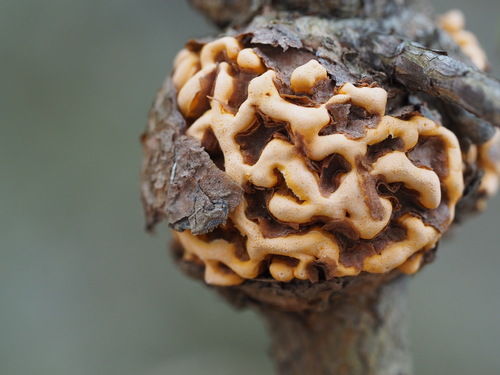
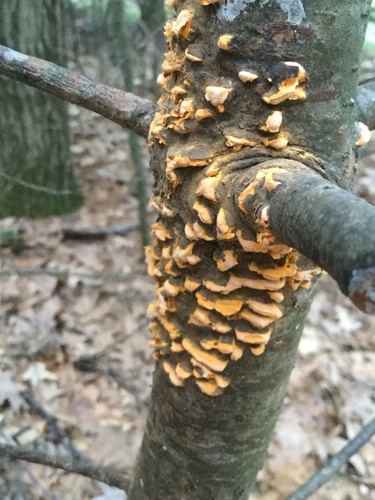
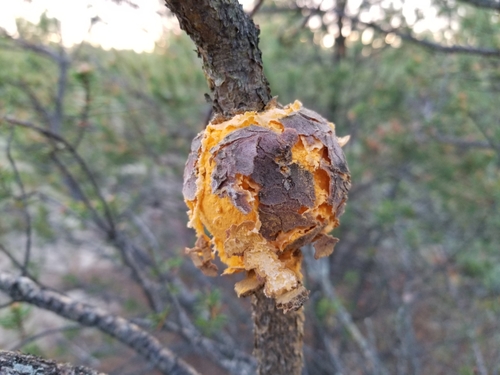
Western gall rust, also called pine-pine gall rust, is a fungal disease of pine trees. It is caused by Cronartium harknessii E.Meinecke, which was formerly named Endocronartium harknessii or Peridermium harknessii. The older name Peridermium harknessii described the fungus's aecial phase under the now-superseded system of dual nomenclature. This causal agent is an autoecious, endocyclic rust fungus that grows in the vascular cambium of its host. The disease affects pine trees (Pinus spp.) that have two or three needles per bundle, including examples such as ponderosa pine, jack pine, and Scots pine. It is very similar to pine-oak gall rust, but unlike that disease, its second host is another Pinus species. Fungal infection leads to gall formation on the branches or trunks of infected host trees. Gall formation is typically not harmful to mature old trees, but it is known to kill younger, less established pine saplings. Galls can range in size from small outgrowths on the tips of branches to grapefruit-sized growths on tree trunks. Damp surfaces on these pine trees create an environment that supports spore germination. These suitable damp surfaces are usually found on very young tissue from the current season's growth. The correct environmental conditions must last for at least 24 hours after a spore lands on the host to give the fungus enough time to germinate, penetrate the host's defenses, and establish itself. Conditions that favor infection usually develop during spring and early summer, when weather is consistently cool and moist. Because spore germination and infection require very specific conditions, western gall rust may not be observed every consecutive year. It is unlikely that both optimal weather conditions and susceptible host tissue will be present at the time of spore release each year. As a result, infection severity is not consistent from year to year. Only minor infections occur in most typical years, but infection can become prolific in some years when the right conditions occur. These years of widespread abundant infection are called "wave years", and they are characterized by consistent cool, wet conditions plus increased local sporulation of C. harknessii. Favorable conditions for large outbreaks of western gall rust do not happen often, but when they do occur, they can affect regions as large as an entire U.S. state. Localized outbreaks are much more common, and these tend to occur in dense, even-aged pine stands.