About Crocus ochroleucus Boiss. & Gaill.
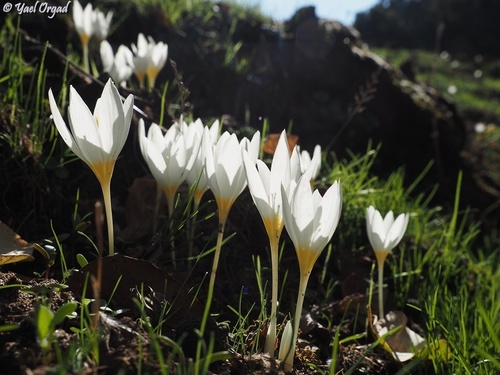
Crocus ochroleucus Boiss. & Gaill. is a herbaceous perennial geophyte that grows from a small corm. Its corm is surrounded by membranous brown tunics. Each corm produces 4 to 6 leaves that emerge at the same time as flowers; the leaves are strongly canaliculate and 1.5–2 mm wide. The basal spathe often surrounds numerous scapes. The floral spathe is diphyllous and partially encloses a long perianth tube. The entire perianth measures 2–3 cm long. Its tepals are elliptical-ovate, cream-white, and yellow and bearded at the base. Anthers are whitish, longer than the filaments, and produce white pollen. Stigmas are orange. The style has three branches that are dilated at the apex, with entire or branched ends. The species specific epithet ochroleucus comes from the Greek words ôchros (yellow) and leukos (white), referring to this crocus's cream-white color. The genus name Crocus derives from the Greek krokos, a name ancient peoples used to refer to the violet-flowered species Crocus sativus. Crocus sativus's large, highly fragrant, bright orange-yellow stigmas produce the famous saffron used to color certain foods and liquors. In Lebanon, this species is known locally as hirsanneen, and it grows abundantly after the first autumn rainfalls. Its corms are sometimes eaten. Members of the Crocus genus have 3 stamens, a characteristic that helps distinguish them from meadow saffron, which belongs to the Lily Family and has 6 stamens. This species grows in rocky places with light soils. On Jebel Jermak in Upper Galilee, it grows alongside Crocus hyemalis and Crocus pallasii. In its native range, it occurs in lower and middle mountains, the South, and Hermon.