About Crithmum maritimum L.
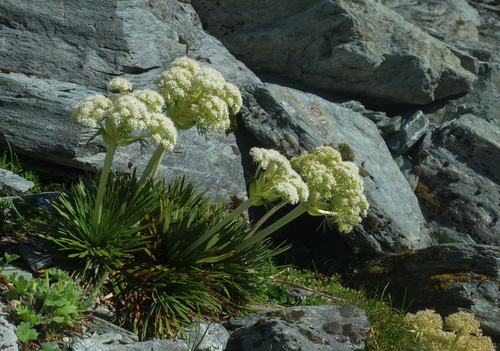
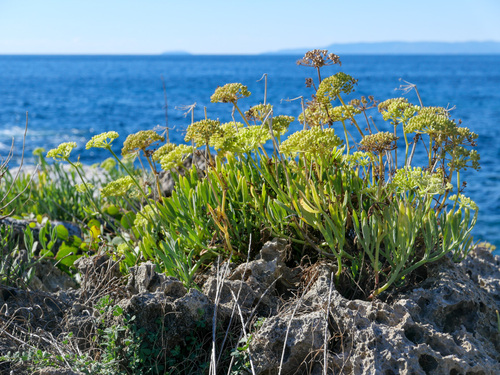
Crithmum maritimum L., commonly known as rock samphire or sea fennel, is a perennial plant that reaches 50 centimetres (20 inches) in both height and width. Its stems are woody at the base, fleshy in other sections, and entirely hairless. It produces fleshy lobed leaves. Its greenish-yellow flowers grow in umbels. Its fruit seed pods are yellow or purple, and reach up to 5–6 millimetres (3⁄16–1⁄4 inch) in size. This species grows on coastlines across much of Europe, extending north to the British Isles, as well as in Macaronesia, parts of West Asia, and North Africa, along the Atlantic, Mediterranean, and Black Sea coasts. In Britain, rock samphire is grown in gardens, where it thrives easily in light, rich soil. Uprooting wild rock samphire is illegal in the United Kingdom under the Wildlife and Countryside Act. The plant's fleshy, divided aromatic leaves were noted by Culpeper to have a "pleasant, hot and spicy taste". It can be prepared in much the same way as marsh samphire (Salicornia europaea): its stems and leaves should be washed and cooked before eating. Stems, leaves, and young seed pods can be pickled, often in spiced salted vinegar. Fresh leaves can be added to salads. Dried, ground sea fennel may also be used as a substitute for salt. Pickled sea fennel preserved in olive oil or vinegar is a traditional food in Italy's Marche region, Croatia's Dalmatia, Greece, and Montenegro's Bay of Kotor. In Italy's Marche region, it is called Paccasassi del Conero, and is used as an antipasto, served alongside fish and meat dishes, and used as a garnish for pizza and sandwiches.