About Crinum flaccidum Herb.
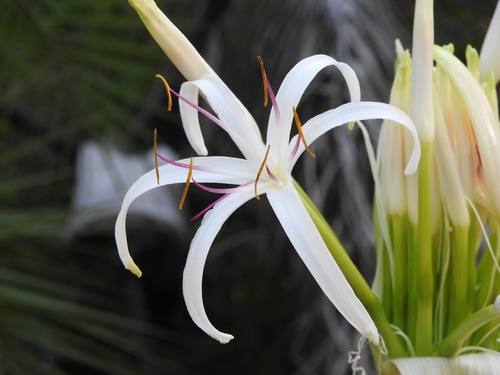
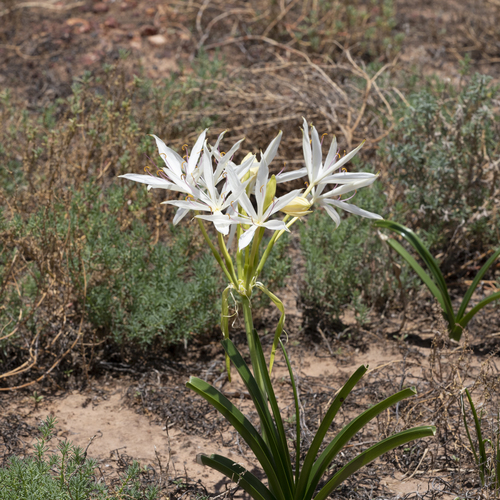
Crinum species are large plants that produce heavy umbels of thin, segmented, lily-like flowers. These plants go dormant at certain times of the year, which creates the perception that they disappear and then reappear above ground. Each plant grows from an egg-shaped bulb, and produces flat, soft leaves that measure 50 cm long by 1 to 4 cm wide. Crinum species are typically found on inland floodways and near rivers.
In his 1889 book *The useful native plants of Australia*, botanist Joseph Henry Maiden wrote that this exceedingly handsome white-flowered plant, which grows inland from the Darling, has bulbs that yield a fair quality arrowroot. Maiden noted that on one occasion near the town of Wilcannia, a man earned a good sum of money producing this arrowroot when flour was almost completely unobtainable, and recorded the species' presence in South Australia, Victoria, New South Wales, and Queensland. Maiden also provided three synonyms for the species: Crinum flaccidum Herb., Amaryllis australasica Ker, and Crinum australis Spreng.
Historically, the genus Crinum was placed in either the Amaryllidaceae or Liliaceae plant families, but current consensus places it in Amaryllidaceae. There are approximately 180 recognized Crinum species worldwide, with 14 recognized species in Australia, 13 of which are native to the continent. C. flaccidum faces taxonomic uncertainty due to widespread hybridization within the Crinum genus, paired with morphological variability both within and between populations.
Crinum species are found in tropical and subtropical regions across the globe, including Africa, Australasia, and India. They occur in all mainland states of Australia. C. flaccidum is broadly scattered along the floodways of inland river systems, primarily in the eastern half of Australia, including eastern Northern Territory, Queensland, New South Wales, north-eastern Victoria, and eastern South Australia. Isolated disjunct populations also occur in the north-west corner of Western Australia.
A wide diversity of insects visit flowering C. flaccidum during March and early April. Anthesis (flower opening) occurs at dusk, which matches the trait preference for sphingophily or phalenophilous moth pollination seen across the Crinum genus. Pollinators observed interacting with C. flaccidum include several species of hawkmoth and honey bees. Effective pollination is done by sphingid moths, as these moths are the only insects with mouthparts long enough to reach nectar held in the species' long floral hypanthia.
The seeds produced by C. flaccidum have a corky coat and weigh approximately 5.3 g (0.19 oz), which is relatively large for plant seeds. These seeds can germinate without an external supply of water, and will occasionally germinate while still attached to the parent plant. Birds have occasionally been observed feeding on the flowers of Crinum species, though the nectar they contain is fairly low in nutritional value.
C. flaccidum is often mistaken for true lilies (family Liliaceae) due to their similar basal leaf arrangement. However, C. flaccidum does not belong to Liliaceae, so it does not share the toxicities characteristic of that family. C. flaccidum has been reported to be toxic to humans, though supporting evidence is inconsistent. The specific toxin responsible is unknown, but it is suspected to be isoquinoline phenanthridine alkaloids. The overall risk of harm is considered low, though vomiting can occur when camping among large numbers of flowering C. flaccidum plants.
Crinum species have been used in traditional medicine to treat ailments for centuries. The bulbs of C. flaccidum were used as a rich starch source by First Nations people of Australia; when cooked, the bulbs could be eaten to produce arrowroot or gruel. However, other reports note that local people generally agree the bulb is poisonous. Recent research into potential pharmacological uses of Crinum species has led to the discovery of over 150 different alkaloids, with recorded effects including analgesic, anticholinergic, antitumor, and antiviral activity.