About Crinum asiaticum L.
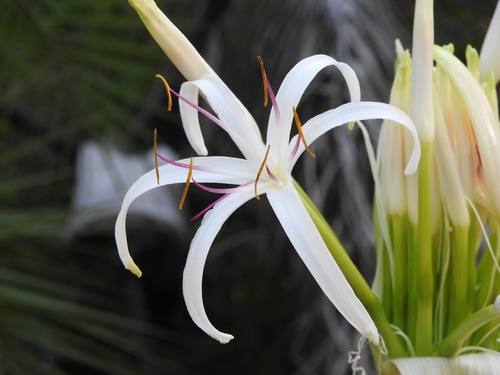
Crinum asiaticum L. is a perennial herb that usually reaches a height of up to 1.2 meters (3.9 feet). It has a distinct leaf base, a spherical pseudobulb, and a cylindrical upper bulb section. The base of the bulb is laterally branched, with a diameter between 6 and 15 centimeters (2.4 to 5.9 inches). The species produces 20 to 30 dark green lanceolate leaves with undulate margins and acuminate, sharply pointed tips. Mature leaves can grow up to 1 meter long, and are 7 to 12 centimeters (2.8 to 4.7 inches) wide or wider. Its inflorescence is an aromatic umbel that holds 10 to 24 flowers, each with six petaloid tepals. The solid, erect flower stem is the same length as the leaves. The inflorescence’s spathe is lanceolate, membranous, and measures 6 to 10 centimeters (2.4 to 3.9 inches) long, while the bractlet is linear and 3 to 7 centimeters (1.2 to 2.8 inches) long. The perianth tube is slender, straight, greenish-white, 7 to 10 centimeters (2.8 to 3.9 inches) long, and 1.5 to 2 millimeters in diameter. The six-lobed corolla is spider-shaped, white, linear, revolute, and attenuate, measuring 4.5 to 9 centimeters (1.8 to 3.5 inches) long and 6 to 9 millimeters wide. Flower pedicels are roughly 0.5 to 2.5 centimeters (0.2 to 1.0 inch) long. The species has six reddish stamens, with 4 to 5 centimeter (1.6 to 2.0 inch) long filaments and linear, attenuate anthers that are roughly 1.5 centimeters (0.6 inches) long or longer. The fusiform ovary grows up to 2 centimeters (0.8 inches) long. The fruit is a green oblate capsule 3 to 5 centimeters (1.2 to 2.0 inches) in diameter. Seeds of Crinum asiaticum are large, with a spongy exotesta. Queen Emma lily, the giant subspecies Crinum asiaticum subsp. asiaticum, can grow up to 2 meters (6 feet 7 inches) tall, and produces darker pink flowers that reach up to 30 centimeters (12 inches) in diameter. The entire Crinum asiaticum plant is toxic, with the bulb being the most toxic part. It contains multiple alkaloids, including lycorine and tazettine. If eaten, the plant causes symptoms such as vomiting, abdominal pain, severe diarrhea, constipation, irregular breathing, rapid pulse, and fever. Severe overexposure can lead to nervous system paralysis and death. The Tao indigenous people of Orchid Island, Taiwan, use slices of this plant’s stem, which they call vakong, tied to heavy objects as fish bait to drive fish into their nets. The Paiwan and Puyuma peoples grow this plant, which they call livakong, as a natural boundary marker.