About Crinia georgiana Tschudi, 1838
Common Name and General Body Form
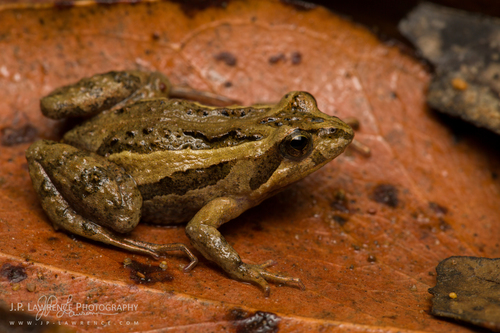
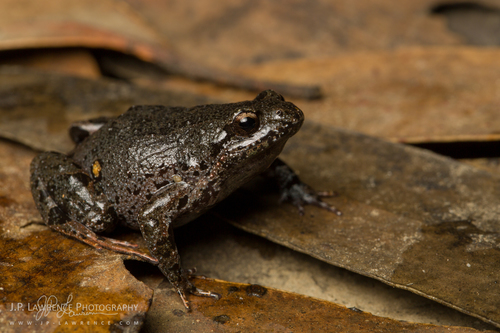
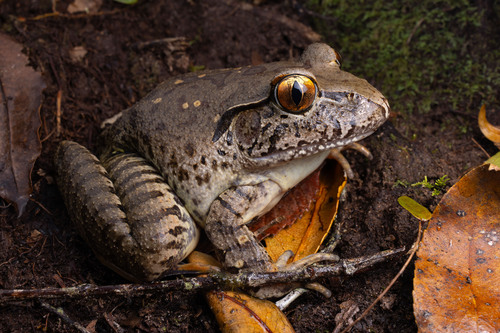
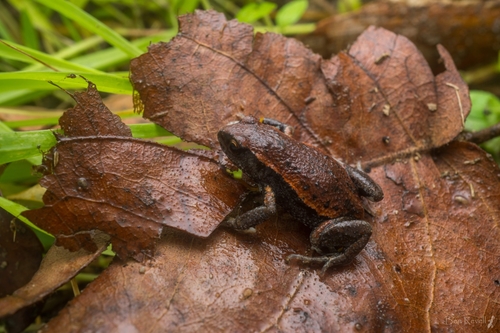
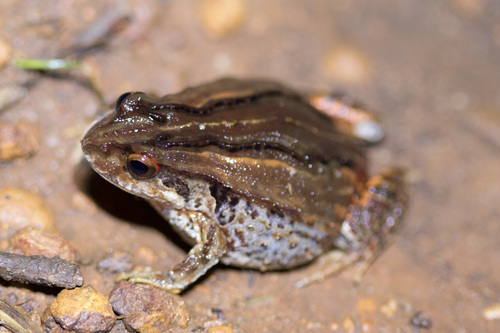
Crinia georgiana, commonly called the quacking frog, is a short, squat, flattened froglet with a large head and short limbs.
Limb and Digit Structure
Like other members of its family, it has long, unwebbed fingers and toes.
Skin Texture
Its dorsal skin is most often bumpy or tubercular, though it can sometimes be smooth; the underside of the body is finely granular.
Genus Polymorphism
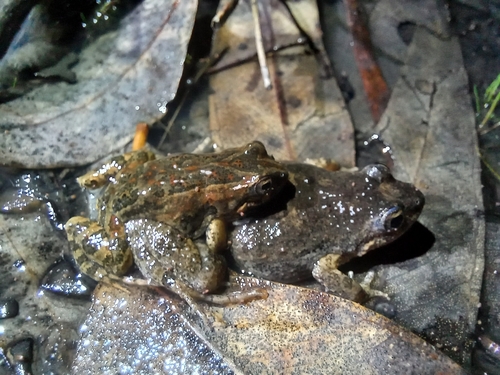
The genus this species belongs to is polymorphic, meaning there is extensive variation in skin color and texture across individuals of the species. Some individuals have skin folds on their back, while others do not.
Dorsal Coloration
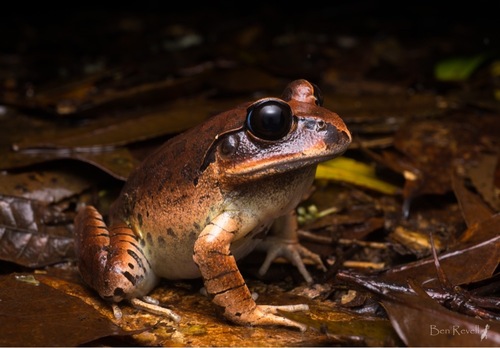
The dorsal coloration ranges from orange to brown to almost black, and may include brown marbling or brown stripes running along either side of the back that help the frog camouflage.
Belly and Limb Base Markings
Males have a dirty-grey belly, while females have a bright white abdomen; both sexes have a small white spot at the base of each limb.
Groin, Thigh and Eyelid Coloration
The groin, and the anterior and posterior surfaces of the thigh are bright red, and the upper eyelids are either red or golden.
Hand Coloration
The frog's hands are pale in color.
Distinguishing Trait Summary
These distinct traits make the quacking frog easily distinguishable from other species.
Tadpole Appearance
Tadpoles of this species are golden with transparent tails.
Testis Mass Trait
Compared to other species in the same genus, Crinia georgiana is unique in having significantly larger testis mass, a feature linked to high levels of sperm competition in the species.
Sexual Dimorphism in Arm Girth
Males of Crinia georgiana generally have greater arm girth than females.
Oral and Vocal Traits
This species also has vomerine teeth, and is one of the only frogs in the family Myobatrachidae that has a variable note number.
Habitat Restriction Drivers
Because water is essential to Crinia georgiana, the species is restricted to coastal plains and forests with abundant water, especially during the winter breeding season.
Specific Habitat Types
It is most often found in shallow water near sandstone outcrops, in marshy bogs, among vegetation, or in human-created habitats with plentiful water such as agricultural lands and rural gardens.
Endemic Range
This froglet is endemic to Australia, found only in southwest Western Australia.
Range Extent
Its range extends from Gingin in the north, inland to Dumbleyung, and east to Cape Le Grand.
Distribution Pattern
Most individuals are distributed along the coast, with very few occurring inland due to the species' requirement for water for survival and aquatic breeding.
Population Status
Current estimates indicate there are more than 50,000 adult Crinia georgiana, and the population size is stable or slightly increasing.