About Crex egregia (W.Peters, 1854)
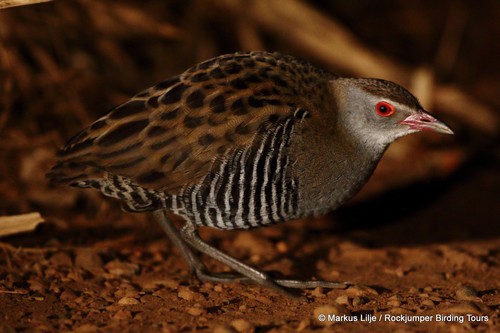
The African crake, Crex egregia, is a small crake that measures 20–23 cm (7.9–9.1 in) in length with a 40–42 cm (16–17 in) wingspan. Males have blackish upperparts streaked with olive-brown, except for the nape and hindneck which are solid pale brown. A white streak extends from the base of the bill to above the eye. The sides of the head, foreneck, throat, and breast are bluish-grey; flight feathers are dark brown; and the flanks and sides of the belly are barred black and white. The eye is red, the bill is reddish, and the legs and feet are light brown or grey. The sexes have similar appearance, though females are slightly smaller and duller than males, with a less contrasting head pattern. Immature birds have darker, duller upperparts than adults, a dark bill, a grey eye, and less barring on the underparts. There are no subspecific or geographical variations in this species' plumage. After breeding, mainly before migration, this crake undergoes a complete moult. Although the African crake lives in fairly open habitats, it does not have the pure white undertail used for signalling by open water or gregarious species like coots and moorhens. The African crake is smaller than the corn crake, which also has darker upperparts, a plain grey face, and a different underparts barring pattern. In flight, the African crake has shorter, blunter wings with a less prominent white leading edge and deeper wingbeats than its relatives. Other sympatric crakes are smaller, have white markings on the upperparts, different underparts patterns, and a shorter bill. The African rail has dark brown upperparts, a long red bill, and red legs and feet. The African crake is found across all of sub-Saharan Africa from Senegal east to Kenya, and south to KwaZulu-Natal, South Africa. It is absent from arid areas of south and southwest Africa that receive less than 300 mm (12 in) of annual summer rainfall. It is widespread and locally common across most of its range, excluding rainforests and drier regions. Nearly the entire South African population of approximately 8,000 birds is found in KwaZulu-Natal and the former Transvaal Province, with large areas of suitable protected habitat in Kruger National Park and iSimangaliso Wetland Park. This crake is only a vagrant to southern Mauritania, southwest Niger, Lesotho, South Africa's northern and eastern Cape Province and North West Province, and southern Botswana. Further from its core range, it is rare on Bioko Island (Equatorial Guinea), there have been two recorded occurrences each on São Tomé and Tenerife; the Canary Islands records are the first for the Western Palearctic. Holocene remains from North Africa indicate the species was more widespread when the climate was wetter in what is now the Sahara. The African crake is a partial migrant. Although it is less skulking than many of its relatives, its movements are complex and poorly studied, so its distribution map is largely hypothetical. It is mainly a wet-season breeder, and many birds move away from the equator once rains provide enough grass cover to allow breeding elsewhere. Southward movement occurs mainly from November to April, and the return north begins when burning or drought reduces grass cover again. This species is present year-round in some West African countries and in equatorial regions, but even in these areas population numbers vary seasonally due to local movements. North-south migration has been recorded within countries including Nigeria, Senegal, The Gambia, Ivory Coast, and Cameroon. Migration occurs in small groups of up to eight birds. It can take one or two months after the start of rains before grass grows tall enough for breeding birds to arrive. Even in southern Africa, some birds may stay after breeding if enough usable habitat remains. The African crake's habitat is predominantly grassland, ranging from wetland edges and seasonal marshes to savanna, lightly wooded dry grassland, and grassy forest clearings. It also occurs in corn, rice, and cotton fields, derelict farmland, and sugarcane plantations located close to water. It uses a wide range of grass species, preferring vegetation 0.3–1 m (0.98–3.28 ft) tall, though vegetation up to 2 m (6.6 ft) tall is acceptable. It normally prefers moister, shorter grassland habitats than the corn crake, and its breeding territories often contain or are located close to thickets or termite mounds. It occurs from sea level up to 2,000 m (6,600 ft), but is rare in higher altitude grasslands. Its grassland habitat is frequently burned in the dry season, forcing the birds to move to other areas. In an East African study, the average area occupied by a single bird was 2.6 hectares (6.4 acres) during breeding season, and 1.97 to 2.73 hectares (4.9 to 6.7 acres) at other times. The highest population densities of the African crake occur in lush or moist grassland such as the Okavango Delta.