About Crepis occidentalis Nutt.
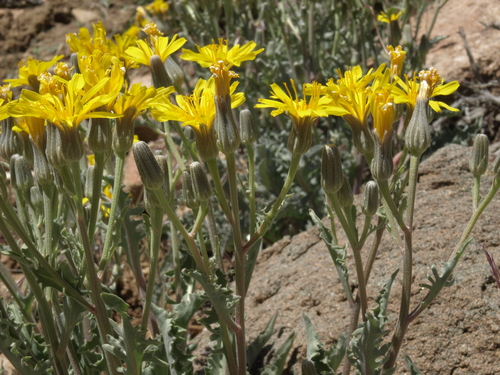
Crepis occidentalis Nutt. is a North American flowering plant species in the Asteraceae family, commonly known as western hawksbeard or largeflower hawksbeard. It is native to western Canada, specifically British Columbia, Alberta, and Saskatchewan, as well as the western United States, ranging from the Pacific Coast to the western Great Plains. This species grows in many different habitat types. It is a perennial herb that grows a grayish, woolly, branching stem up to around 40 centimeters (16 inches) tall from a deep taproot. Its woolly, toothed leaves located at the base of the plant can reach up to 30 centimeters (12 inches) in length. Its inflorescence produces several clusters of flower heads, which have hairy, often glandular phyllaries, many yellow ray florets, and no disc florets. The fruit is a ribbed achene with a frilly pappus at its tip. Four recognized subspecies of Crepis occidentalis have documented distributions: Crepis occidentalis subsp. conjuncta Babcock & Stebbins occurs in California, Colorado, Montana, Oregon, Washington, and Wyoming; Crepis occidentalis subsp. costata (A.Gray) Babc. & Stebbins occurs in British Columbia, Saskatchewan, California, Colorado, Idaho, Montana, Nevada, Oregon, Utah, Washington, and Wyoming; Crepis occidentalis subsp. occidentalis occurs in Alberta, British Columbia, Saskatchewan, Arizona, California, Colorado, Idaho, Montana, Oregon, New Mexico, Nevada, South Dakota, Utah, Washington, and Wyoming; Crepis occidentalis subsp. pumila (Rydb.) Babc. & Stebbins occurs in British Columbia, California, Idaho, Montana, Nevada, Oregon, Utah, and Washington. Western hawksbeard is occasionally cultivated by wildflower gardeners for its large, deep yellow blooms. Its taproot cannot be divided for successful propagation, so cultivated plants are grown directly from seed. Author Claude A. Barr considered this species the most attractive in the genus Crepis, and stated that all other species in the genus are "for the birds."