About Crepidiastrum tenuifolium (Willd.) Sennikov
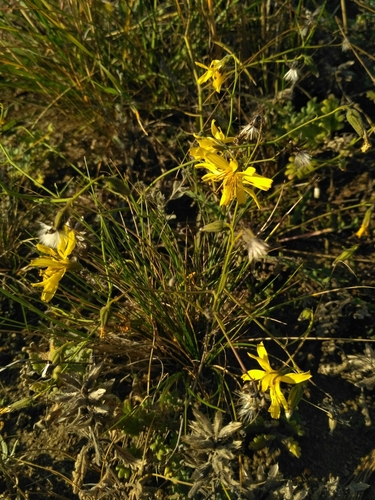
Crepidiastrum tenuifolium (Willd.) Sennikov is a perennial herb, 10 - 70 cm tall, forming a rosette. The taproot is strong and woody. The caudex is woody, branching over time and retaining residues of old leaf - bases. Stems can be solitary or few, erect, usually branching in the upper half and leafy, with ascending - erect branches. Rosette leaves are numerous. The petiole is 3 - 9 cm long, with long brown tomentose on the adaxial side and a somewhat expanded base. The leaf blade is narrowly elliptic, 7 - 17 × 2 - 5 cm, pinnatisect to pinnatipartite, with 6 - 12 pairs of lateral lobes that are opposite to alternate, variable in shape (narrowly elliptic, lanceolate, or linear), undivided or sparsely divided with linear segments, and an acute apex. The terminal lobe is similar to the lateral ones. Stem leaves are similar to rosette leaves but become smaller and less divided or undivided towards the upper part of the stem. The synflorescence is corymbiform or paniculiform - corymbiform, having some capitula. Each capitulum contains 10 - 15 florets. The involucre is narrowly cylindric, 8 - 11 mm long. The phyllaries are dark green, with sparsely curled pilose on the abaxial side or rarely glabrous, often crested or corniculate below the apex, and an acute apex. There are few outer phyllaries, narrowly ovate, with the longest being 1/3 - 1/2 as long as the inner ones, and an acute apex. There are 8 inner phyllaries. The achene is black to blackish, fusiform, 4 - 6 mm long, with 10 - 12 ribs, shortly and rather inconspicuously scabrid, and the apex attenuates to a weakly beaked structure. The pappus is white, 4 - 6 mm long. Flowering and fruiting occur from July to September, and the chromosome number is 2n = 10.
Another description: It is a perennial plant. The taproot is woody, thick, long, and vertical, with a short, woody caudex 1 - 4(6) cm thick or a few - headed caudex, covered with dark - brown remnants of petioles of dead basal leaves. Stems are few, less often solitary, 15 - 50(60) cm high, 1.5 - 3.5-(5) cm thick at the base, erect, cylindrical, longitudinally striate, solid, branching above, from the base or middle, less often only in the upper part, with erect, obliquely upward - directed or rather strongly divergent branches, leafy, green or violet below, glabrous along with glaucous - green leaves, less often sparsely crisped - hairy below the capitula. Basal leaves are numerous, 5 - 20(28) cm long and 2 - 6(8) cm wide, pinnatisect or deeply pinnatipartite, with oblong, lanceolate, linear, less often linear - filiform, usually acuminate, entire, toothed or divided lateral segments (with one or two teeth or lobes on each side) or 6 - 12 pairs of lobes and a terminal segment not larger than the laterals, very rarely lyrate or irregularly toothed, on long, non - winged, basally strongly expanded petioles, with leaf axils densely tomentose from dirty rusty hairs, almost as long or two - thirds as long as the lamina, and the leaves do not wither before flowering. Lower and middle cauline leaves are like basal leaves. Upper cauline leaves are pinnatipartite, pinnatilobate or entire, then linear or linear - filiform, sessile, non - amplexicaul. Apical leaves are very small, sometimes with individual crisped hairs. Capitula are usually numerous, with 8 - 15 florets, on erect or slightly bent, slender, 0.3 - 2 cm long peduncles, in a lax corymbose inflorescence. The involucre is cylindrical, 8 - 10.5(11) mm long and 2.5 - 3.5(4) mm wide (at the beginning of flowering). The outer surface of involucral bracts is covered with more or less dense or scattered, somewhat long, grayish, eglandular, crisped hairs, very rarely glabrous, with well - developed, narrow, bent horns near the apex. There are five to seven outer bracts, oblong - lanceolate, acute, unequal, with a membranous border, one - fourth to two - fifths as long as the inner ones. There are (seven) eight (nine) inner bracts, oblong - linear, obtuse, equal, with a narrow membranous border (innermost) and one prominent vein, and crisped - hairs along the margin at the apex, glabrous inside. The receptacle is finely pitted and smooth. Florets are yellow, one and a half to two times as long as the involucre. The corolla is 11 - 15 mm long, ligules are up to 3 mm wide, the corolla tube is 2.5 - 3 mm long, scatteredly puberulent with acicular, scabrous hairs, and the style branches are yellow. Achenes are similar, black, 4.5 - 7 mm long and 0.7 - 1 mm wide, fusiform, distinctly compressed dorsally, gradually narrowed above into a short, yellowish, more or less thin, beak - like structure, 0.7 - 1.5(2) mm long and 0.2 - 0.3 mm wide, abruptly expanded at the apex into an almost flat disk, with 10 - 12(13) obtuse, unequally thick ribs, densely covered with short (visible under high magnification of a binocular microscope!) upward - directed spines and very short, almost appressed, hairs between the ribs (especially immature achenes). The pappus consists of 4 - 6 mm long, white, scabrous, thin and soft hairs, which fall singly with difficulty.