About Crematogaster scutellaris (Olivier, 1792)
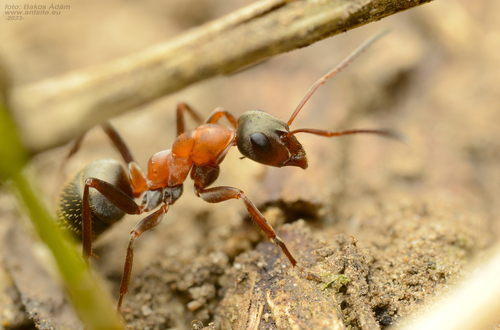
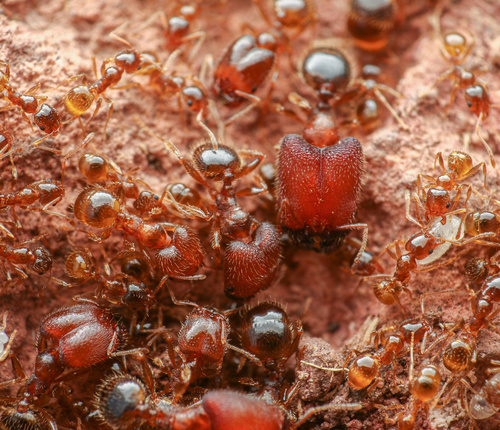
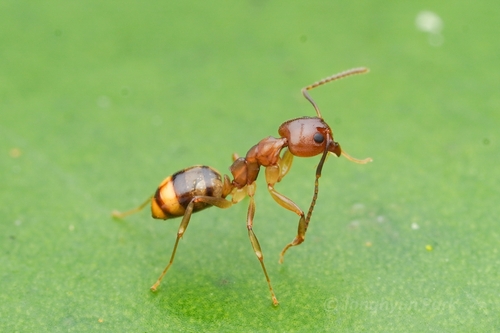
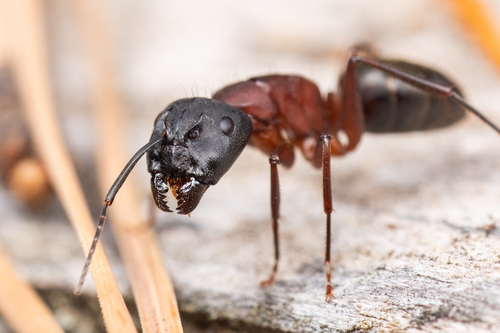
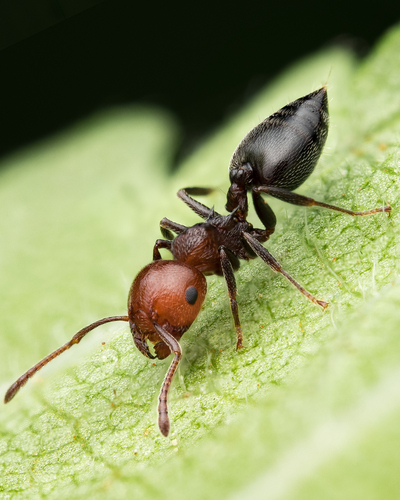
Queen Crematogaster scutellaris ants can reach a body length of approximately 8 millimeters, while workers rarely grow longer than 5 millimeters. These ants have a reddish-colored head, paired with a black thorax and abdomen. Their abdomen has a characteristic shape that gradually tapers toward its apex. When they feel threatened or attacked, they raise their pointed abdomen in a menacing posture, and release a small drop of pheromones from the rear of their body. The scent of this pheromone triggers a full general mobilization of the entire nest, and any intruder will quickly be surrounded by a large group of aggressive worker ants. This species has a typical Mediterranean distribution, and is found across Europe, the Near East, and North Africa. Crematogaster scutellaris forms independent, usually monogynous colonies, but may also have oligogynous colonies – colonies where workers accept multiple queens, though these queens are aggressive toward one another. Winged reproductive males and queens can be found at the end of summer, and may sometimes be seen as late as the end of October if temperatures remain mild. Colonies are most commonly built inside stumps, fallen logs, or dead branches. Nests are constructed from a mixture of chewed wood and humus. Between March and October, worker ants primarily collect and carry back two types of resources: sugary liquid substances, and solid materials such as the remains of arthropods and small insects. Egg-laying usually occurs during the summer, and this species is very prolific. Larvae most commonly hatch in September, and enter diapause to overwinter in their second larval instar, staying in this stage from November to February at approximately 10 °C. The following spring, the larvae molt into their third instar, and pupate during the summer. New worker adults emerge by mid to late summer, while sexually mature reproductive individuals emerge in late August. These ants are natural predators of Thaumetopoea pityocampa, a moth species that is a devastating pest of Mediterranean pines, especially Pinus halepensis. Crematogaster scutellaris also transports live aphids into oak-gall nests. There is currently no evidence that these ants immediately predate on the aphids inside the galls. It is likely that the aphids are stored in the galls to overwinter as part of a mutualistic relationship, and/or that they serve as a stored food source for the ants.