About Creatonotos gangis (Linnaeus, 1763)
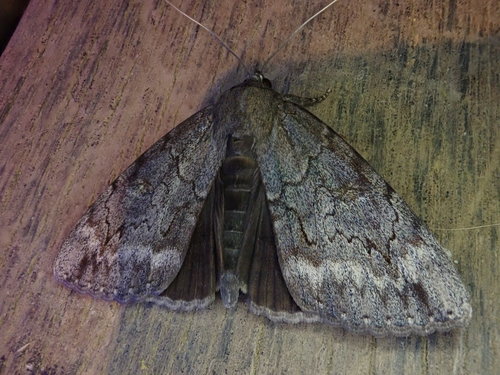
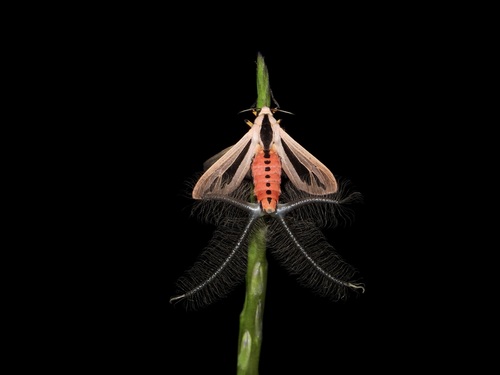
The scientific name of this species is Creatonotos gangis (Linnaeus, 1763). Adults have brown forewings each marked with a dark streak, white hindwings, and a wingspan of 4 cm (1.6 in). Their abdomen is red, or yellow in rarer cases. Males have four large grey coremata behind their abdomen that can grow longer than the abdomen when inflated. Yellow, round eggs are laid in rows on the leaves of food plants. Caterpillars are brown, hairy, and have a yellow stripe running along the back. They have a polyphagous diet, and are considered a minor pest that feeds on the crops groundnuts, rice, ragi, sorghum, pearl millet, coffee, sweet potato, and lucerne. A description published in The Fauna of British India, Including Ceylon and Burma: Moths Vol. II, where the species is listed as C. interrupta, notes that antennae are minutely ciliated in both sexes. The head, thorax, and fore wing are pale pinkish ochreous. Palpi and legs are smoky black, with yellow femora; the thorax has a broad dorsal band. The upper side of the abdomen is crimson, with black spots arranged in dorsal and lateral series. The fore wing has a broad black fascia below the median nervure, two black spots at the end of the cell, and a broad streak beyond the lower angle. The hind wing is pale or dark fuscous; some specimens have a sub-marginal series of black spots. The variety continuatus has extra black streaks on the fore wing below the costa, in the cell, above the inner margin, and in the marginal interspaces, though intergrades between this variety and the typical form exist. The larva in this description is black, sparsely covered with long hairs, has a white-marked head, a yellow dorsal line with a series of orange spots, and pale prolegs. Creatonotos gangis is distributed across South East Asia and parts of Australia. Its known Asian range includes eastern Indonesia, India, Iran, Sri Lanka, China, Japan, Thailand, and New Guinea. In Australia, it is found only in northern regions of Western Australia, the Northern Territory, and Queensland, reaching as far south as Mackay. In terms of ecology, adult males secrete the pheromone hydroxydanaidal to attract mates. Both the amount of this pheromone produced, and the size of the coremata that produce it, depend on the diet the moth had during its caterpillar stage. If a larva’s diet includes pyrrolizidine alkaloids, the coremata grow large and the male will release up to 400 micrograms (0.4 milligrams) of hydroxydanaidal. If the diet does not contain pyrrolizidine alkaloids, coremata do not grow large and no pheromone scent is produced. The larvae of C. gangis can cause extensive damage to the foliage of pomegranate trees.