About Craugastor rugosus (Peters, 1873)
Species Introduction
Craugastor rugosus is a relatively large species of rain frog.
Adult Size
Females reach up to 69 mm (2.7 in) in snout–vent length, while males reach up to 44 mm (1.7 in).
Head and Eye Morphology
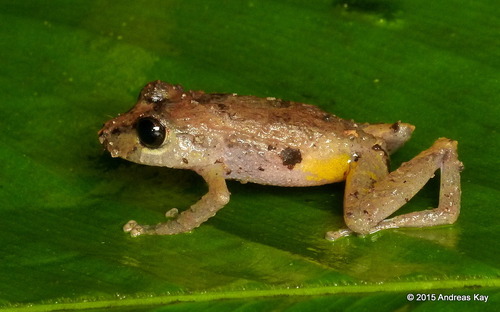
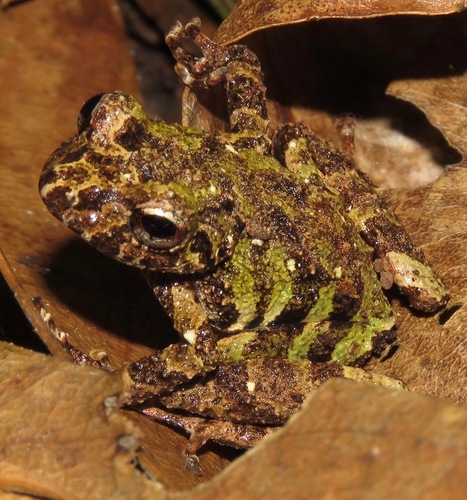
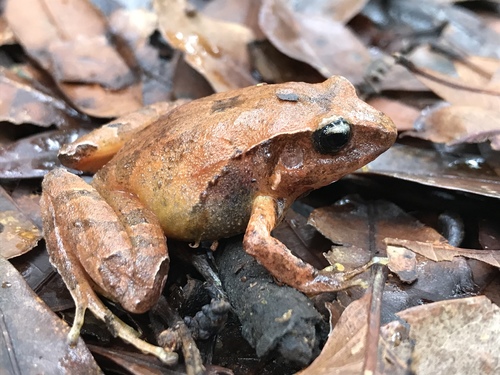
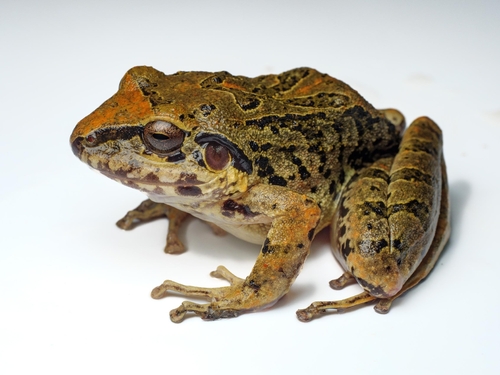
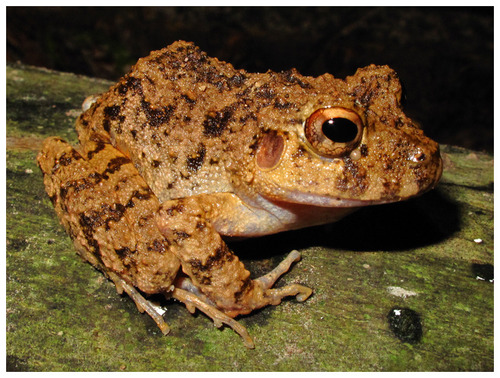
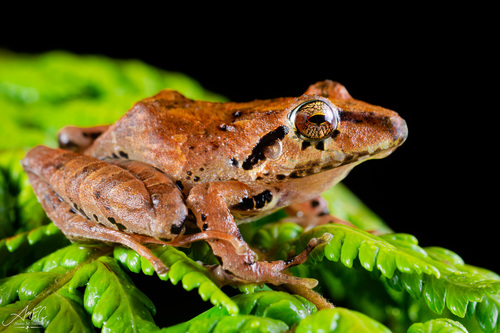
Individuals have large heads. Their eyes have black irises, and the upper eyelid is covered in warts and bumps, with crests located just behind the eyes.
Dorsal Skin Texture
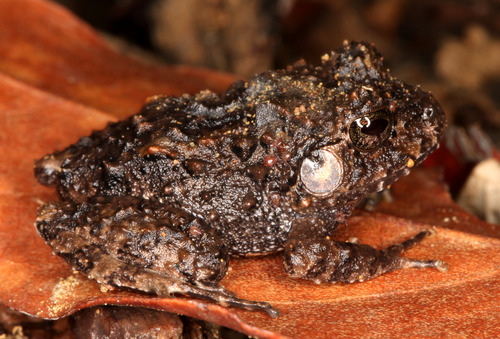
The back (dorsum) is covered in warts, giving the frog a toad-like appearance. Hourglass-shaped ridges run across the upper back, lined with lighter-coloured stripes.
Limb Structure
There is no webbing between the limb digits.
Dorsal Coloration
The dorsum is coloured dark brown, dark grey, or black.
Ventral Body Coloration
The frog's ventral surface is mottled brown with white and red.
Thigh and Groin Coloration
The ventral surfaces of the thighs can be yellowish or orange, and the inner thighs have alternating black and bright scarlet red bars; these black bars extend onto the dorsal surface of the thighs. The groin displays contrasting bright white and black markings.
Juvenile Coloration
Juveniles have different colouration than adults: the dorsal warts are initially white-tipped and darken as the individual ages, the inner thighs are barred with white and black, and the ventral surfaces of the legs and groin are orange-red.
Taxonomic Note on Stomach Wall Description
Noble noted that C. rugosus appears to have a noticeably thicker, more robust stomach wall than other species formerly classified in Eleutherodactylus (which has since been split into Craugastor and other genera), but his description of C. rugosus was based on dissections of a mixed group of species, mostly C. megacephalus.
Biological Traits
This species is thought to likely not produce a mating call, and has a karyotype of 2n=20.
Initial Distribution Understanding
Current understanding places most of the species' distribution in eastern Costa Rica. Initially, until at least 1923, it was believed to not occur in Costa Rica at all, and instead exist in two separate populations in Nicaragua and Panama, as recorded by Fritz Nieden.
Current Confirmed Distribution Range
According to Savage (2002) and Frost (2015), C. rugosus is now known to occur on Pacific-facing slopes and lowlands from the lower Rio Carara region of Costa Rica south to southern far western Panama.
Potential Distribution Uncertainty
It is possible that the species' actual range extends further north and east than this recorded distribution, but a history of taxonomic confusion makes this difficult to confirm.
Costa Rica Specimen Records
A specimen was collected by Henry Sterling Blair in Zent, Limón Province, Costa Rica in 1996 and is held at Harvard University's Museum of Comparative Zoology (MCZ).
Nicaragua Specimen Records
Out of 31 specimens originally identified as C. rugosus collected during the US occupation of Nicaragua, two 1916 specimens from Tuli Creek (the Tule River, south of San Miguelito, Río San Juan Department) are still labelled as this species and held at the MCZ. The MCZ also holds another specimen reportedly collected in 1992 at the Escondido River near Bluefields, Nicaragua.
Confirmed Costa Rica Populations
In Costa Rica, confirmed populations are found in Carara National Park, the Fila Chonta mountains, the Osa Peninsula, and the harbour town of Quepos, all in Puntarenas Province.
Habitat Types
This frog occurs in hot humid tropical lowland rainforests, moist premontane forest, secondary forest, plantations, and heavily altered former forest habitats.
Microhabitat and Activity
It is most often found in forest leaf litter, and has been observed hopping on the forest floor during the day.
Altitudinal Range
According to Savage (2002), it occurs at altitudes ranging from 10 m (33 ft) to 1,220 m (4,000 ft) above sea level.
Diet and Feeding
It is likely an ambush predator that generally preys on beetles, but may also attack lizards and other frogs.