About Craterellus tubaeformis (Fr.) Quél.
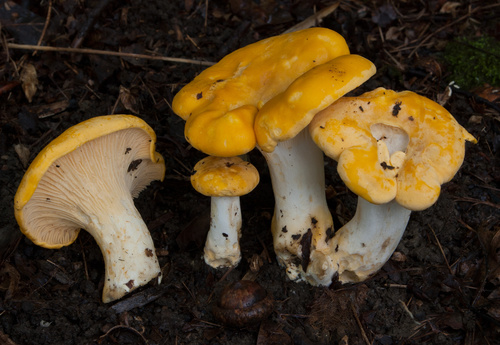
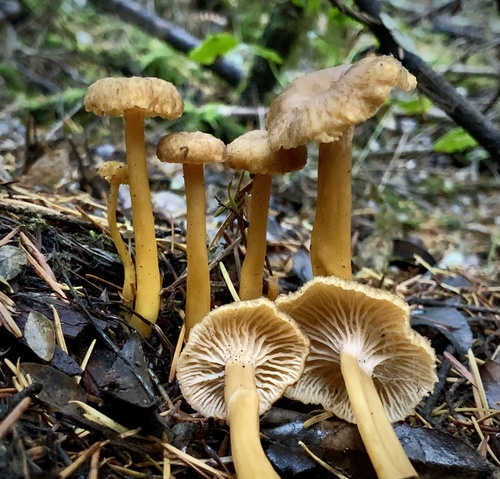
Craterellus tubaeformis (Fr.) Quél. is a mushroom with yellow-toned flesh and a grayish-brown cap. Its cap measures 1–4 centimetres (1⁄2–1+1⁄2 inches) wide, is generally flat with a depressed center, funnel-shaped, waxy, and has a wavy margin. It has a mild odor and taste when cooked, and a very distinctive smoky, peppery taste when raw. The gills of this mushroom are shallow, decurrent, forked, and pale. The stalk is hollow, measuring 2–12 cm (1–4+1⁄2 in) tall and 1 cm or less wide. Its spores are whitish, elliptical, and smooth, and produce a light orangish-pink spore print. It usually fruits later in the season than other mushrooms, sometimes growing near Hydnum repandum, and typically grows in large groups.
This species is distributed across temperate and cold regions of North America near both coasts, Europe (including Scandinavia, Finland, Russia, and the British Isles), Asia (including the Himalayas, Assam, the central Indian subcontinent, and Thailand). It grows most commonly in forests with abundant well-rotted coarse woody debris, on moss or rotten wood; in North America, it occurs mostly in conifer bogs. In the Pacific Northwest of North America, it can be found from November to January.
Craterellus tubaeformis is mycorrhizal, meaning it forms symbiotic associations with plants, which makes cultivation difficult. Western North American populations of this species form ectomycorrhizal relationships with western hemlock (Tsuga heterophylla) and Douglas-fir (Pseudotsuga menziesii).
Though it is small in size, this is a choice edible mushroom. It can be eaten with meat, in soups, pasta, and many other dishes.