About Craterellus cornucopioides (L.) Pers.
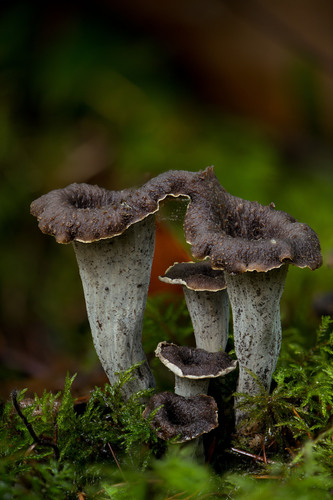
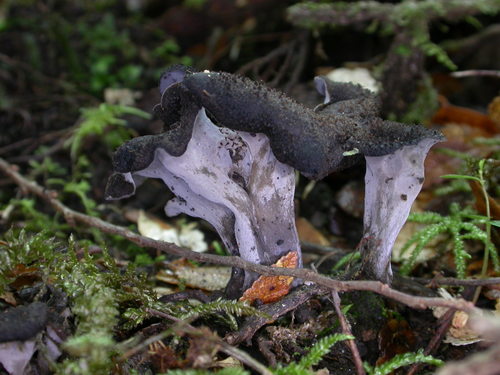
Craterellus cornucopioides (L.) Pers. produces funnel-shaped fruiting bodies that flare out at the top, with a stalk that blends seamlessly into the cap. The cap ranges from 0.5–8 centimetres (1⁄4–3+1⁄4 inches) wide, and the entire fruiting body reaches about 10 cm (4 in) in height, and can grow exceptionally to 15 cm (6 in). The upper inner surface of the fruiting body is black or dark gray, and very rarely yellow. The lower outer fertile surface is a much lighter shade of gray. The fertile surface is mostly smooth, but may have decurrent wrinkles. It may carry a dusting of spores, which are buff-colored when deposited in a spore print. Spores are elliptical, measuring 8–11 μm by 5–7 μm, and basidia are two-spored. This fungus grows in woodlands across Europe, East Asia, North America, and Australia. It mainly grows under beech, oak, or other broad-leaved trees, particularly in mossy, moist locations on heavy calcareous soil, and typically grows in groups. Because of its dark color, it easily blends into forest floor leaf litter, leading mushroom foragers to compare searching for it to looking for black holes in the ground. In the American Pacific Northwest, it fruits from November to March. In Europe it is generally common, but is rare in some countries including the Netherlands; across most of Europe it appears from June to November, and in the United Kingdom it fruits from August to November. In Australia, it grows in rainforest gullies, often associated with Nothofagus species, and fruits from January to May. Despite its unappealing appearance, this species, commonly called horns of plenty, is an edible, choice mushroom. One Portuguese study reports that 100 grams of dried C. cornucopioides contains 69.45 g of protein, 13.44 g of carbohydrates (most of which is the sugar alcohol mannitol), 4.88 g of fat, for a total of 378 calories. It contains fatty acids, primarily polyunsaturated, along with phenols, flavonoids, and 87 mg of vitamin C. Along with Cantharellus cibarius (golden chanterelles), C. cornucopioides is a significant source of biologically active vitamin B12, with 1.09–2.65 μg per 100 g of dry weight. When dried, this mushroom develops notes reminiscent of black truffle, and dried C. cornucopioides can be crumbled and used as a condiment.