About Crataegus rhipidophylla Gand.
Crataegus rhipidophylla Gand. is a shrub or tree that grows up to 7 metres (23 ft) tall. It bears stout thorns that can reach 1.5 cm (5⁄8 in) in length. Its leaf blades are dark green, with 2–4 pairs of acute or subacuminate lobes. A key identifying trait of this species is its finely serrated lobe margins, which distinguish it from Crataegus monogyna, which has irregularly serrated lobe margins with relatively coarse teeth. The basal lobes of leaf blades on flowering shoots have between 6 and 25 teeth each, and its stipules are either serrate or serrate-denticulate.
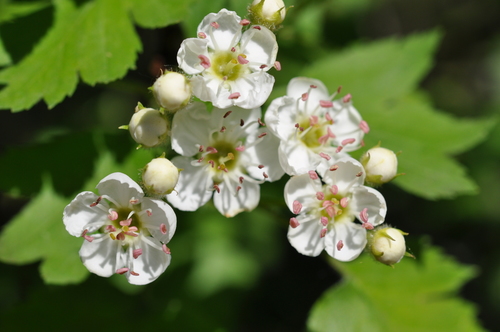
Its inflorescences are corymbs 3–4.5 cm (1+1⁄8–1+3⁄4 in) long, holding 5–15 loosely arranged white flowers. The hypanthium measures 3–5 mm (1⁄8–1⁄4 in) long. Sepals are somewhat narrowly triangular, between 1 and 2.6 times as long as they are wide. Each flower has 14–20 stamens with purple anthers.
Besides the finely serrated leaf lobe margins, the number of styles or pyrenes is another useful identifying characteristic. Flowers of C. rhipidophylla have 1 style, which produces fruit with 1 pyrene; rarely, they may have up to 2 styles or pyrenes. This feature matches C. monogyna, and differs from C. laevigata, which typically has 2 or 3 styles or pyrenes (and may occasionally have 1, 4, or at most 5).
Fruits are either bright or dark red, 8–15 mm (3⁄8–5⁄8 in) long, and between 1.3 and 2 times as long as they are wide. This species flowers in May and June, and fruits develop from June through October.
Crataegus rhipidophylla is a subatlantic species native to Eurasia. Its native range covers southern Scandinavia, the Baltic region, France, the Balkan Peninsula, Asian Turkey, Caucasia, the Crimea, and Ukraine. It grows from sea level up to an altitude of 1,800 m, and can grow on limestone, granitic, or volcanic rock substrates. It is one of the few shade-tolerant hawthorn species, found growing in shaded areas within continuous forests.