About Crataegus monogyna Jacq.
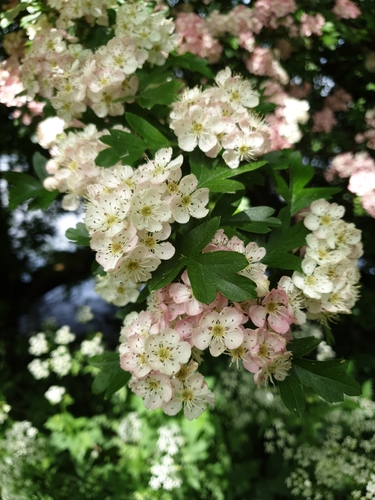
Crataegus monogyna Jacq., commonly called common hawthorn, is a shrub or small tree that grows up to around 10 metres (33 feet) tall, with a dense crown. Its bark is dull brown with vertical orange cracks, and younger stems carry sharp thorns roughly 12.5 millimetres (1⁄2 inch) long. Its leaves measure 20 to 40 mm (3⁄4 to 1+1⁄2 in) long; they are obovate, deeply lobed (sometimes almost all the way to the midrib), with lobes spreading at a wide angle. The upper leaf surface is dark green, while the underside is paler. This species produces hermaphrodite flowers in late spring — May to early June in its native range. Flowers grow in corymbs holding 5 to 25 blooms together. They have numerous red stamens, a single style, a moderate fragrance, and are most often white, though they are frequently pink. Pollination happens via midges, bees, and other insects. After pollination, the plant produces many small, oval dark red fruits called haws later in the year. Haws look like berries structurally but are actually pomes, each containing a single seed inside a hard stone called a pyrene. Haws grow in groups of two or three along smaller branches; they are pulpy with a delicate taste. On average, haws persist on the plant for 107.3 days, with an average of 2.8 seeds per fruit. Fruits are 75.7% water by average weight; their dry weight is made up of 9.0% carbohydrates and 1.0% lipids. Common hawthorn is native to Europe, including Ireland and Britain. It is also found naturally in northwestern Africa and Western Asia, and has become naturalized in the Pacific Northwest region of North America. It grows in disturbed, semi-cleared areas. In ecology, haws are an important food source for wildlife over winter, particularly for thrushes and waxwings. These birds eat the fruits and disperse the species' seeds through their droppings. In open fields, excessive animal grazing removes new vulnerable shoots of C. monogyna, preventing the young plants from growing upward and forcing them to develop an irregular horizontal shape along the ground. A study conducted in Wales found that current rates of sheep overgrazing could lead to the local extirpation of the species within 60 to 70 years. As a food source, the haws of common hawthorn are sometimes described as edible raw, but they are too dry to be widely desirable. They are most commonly processed into jellies, jams, syrups, or wine, or used to add flavor to brandy. Young tender leaves of the plant can be added to salads, and the petals are also edible. Hawthorn petals were included in the medieval English recipe for spinee, an almond milk-based pottage recorded in The Forme of Cury by the head chef of King Richard II, around 1390. In traditional herbalism, C. monogyna is one of the most common species used as the herb "hawthorn". The plant parts typically used are sprigs that hold both leaves and flowers, or alternatively the fruit. Evidence-based medicine has investigated hawthorn for use in treating cardiac insufficiency. C. monogyna is a source of antioxidant phytochemicals, especially in extracts made from its leaves and flowers.