About Crataegus flava Aiton
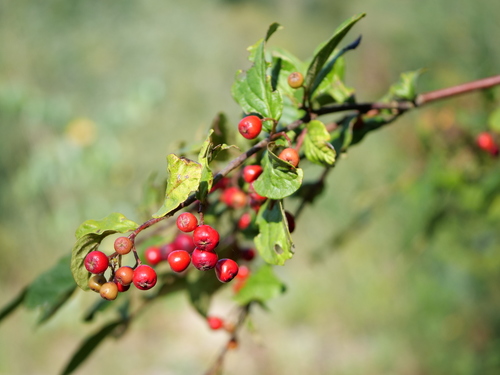
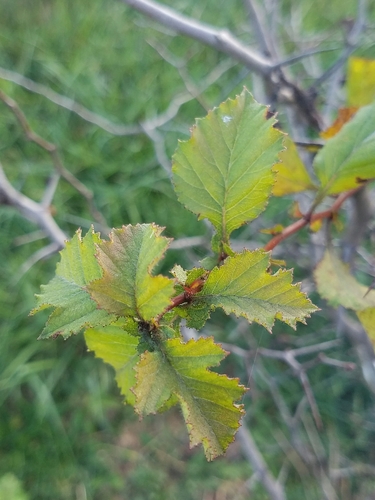
Crataegus flava Aiton, commonly known as summer haw and yellow-fruited thorn, is a hawthorn species native to the southeastern United States, ranging from Virginia to Florida and west to Mississippi. A naming error by Sargent resulted in the name C. flava being, and still often being, applied to an entirely different species, C. lacrimata, which falls into the distinct series Lacrimatae. A separate species group called Flavae was originally thought to be related to the misidentified C. flava; though we now know these species are not related, the group name remains unchanged. Because the true identity of this species has only recently been clarified, the name C. flava is very rarely used correctly. Some C. flava individuals produce red fruit, and these red-fruited plants have sometimes been classified as a separate species named Crataegus senta. Like most hawthorns, plants similar to C. flava produce edible fruit that can be made into jellies and jams. The fruit has a mealy, slightly dry flavor, grows in large clusters, and some fruits are shaped like pears. Also like most hawthorns, the wood of C. flava is hard, and can be used to craft small tools. C. flava grows in upland habitats, including second growth mixed forests, open pinelands, sand pine ridges, deciduous woodlands, oak-hickory woodlands, and scrub oak woodlands. It most often grows in sandy, well-drained soil, and can also be found in disturbed areas such as old fields, fence rows, and right-of-ways.