About Cranioleuca vulpina (Pelzeln, 1856)
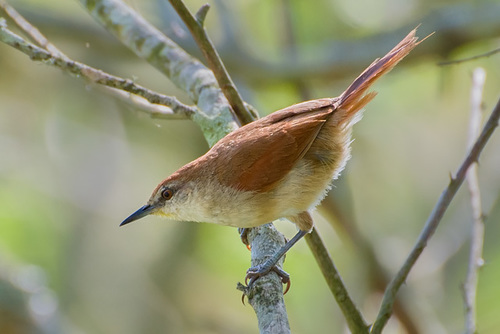
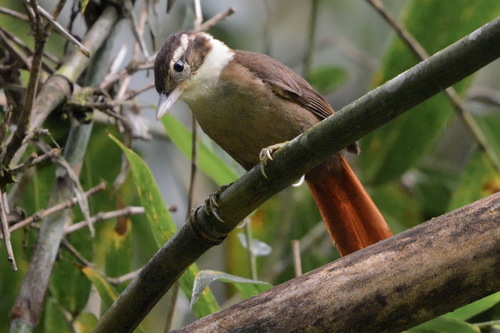
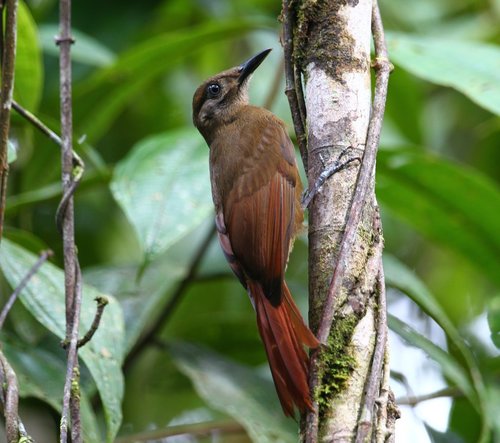
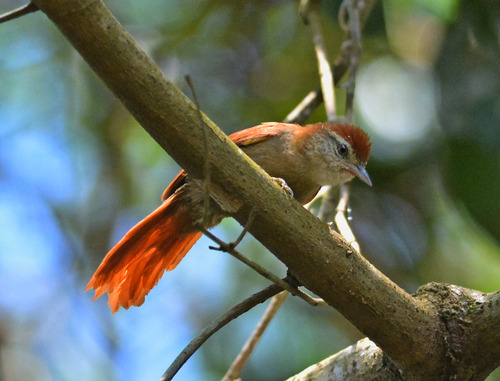
The rusty-backed spinetail (Cranioleuca vulpina) measures 15 to 16 cm (5.9 to 6.3 in) in length and weighs 14 to 17 g (0.49 to 0.60 oz). Males and females have identical plumage. Adults of the nominate subspecies C. v. vulpina have a light brownish face marked with faint streaks and spots, with a buff supercilium and a narrow dark brownish line behind the eye. Their forehead is brown, their crown and back are reddish chestnut, their rump is brown, and their uppertail coverts are reddish chestnut. Their tail is also reddish chestnut. Their wings are reddish chestnut with darker dusk-colored tips on the flight feathers. Their chin is buff-white, and their throat is buff. Their breast is light brown with faint paler streaks, their belly is plain light brown, and their flanks and undertail coverts are a slightly darker brown. Their iris is dark reddish brown, their upper mandible (maxilla) is black, their lower mandible (mandible) ranges from dull horn to silvery horn, and their legs and feet are dull greenish olive or grayish. Juveniles have more grayish upperparts than adults, with a variable ochraceous wash and faint mottling on their underparts.
Four subspecies are recognized, each with distinct traits and ranges: C. v. apurensis is the darkest overall, particularly on the crown, wings, and tail, and is found in Apure state, western Venezuela. C. v. foxi has darker rufous upperparts than the nominate subspecies, and occurs in Cochabamba Department, central Bolivia, and possibly Beni Department. C. v. reiseri is paler than the other subspecies but has more rufescent upperparts; its underparts are more buffy than the nominate's and lack streaking, and it is found in northeastern Brazil. The nominate subspecies C. v. vulpina ranges across northeastern Colombia, central and southern Venezuela, western Guyana, northern and central Brazil, extreme eastern Bolivia, and extreme northeastern and eastern Paraguay. The South American Classification Committee of the American Ornithological Society only has sight records for this species from Guyana, and thus classifies it as hypothetical in that country.
The rusty-backed spinetail lives in a variety of landscapes that are all located on or near water. These habitats include gallery forest, scrub on river islands, thickets along rivers, várzea forest, and shrubby areas around lakes and streams. In terms of elevation, it occurs from near sea level up to 400 m (1,300 ft).