About Cranioleuca pyrrhophia (Vieillot, 1818)
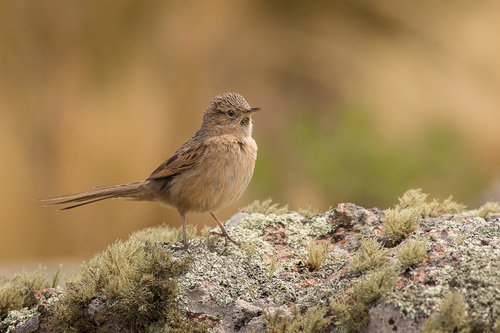
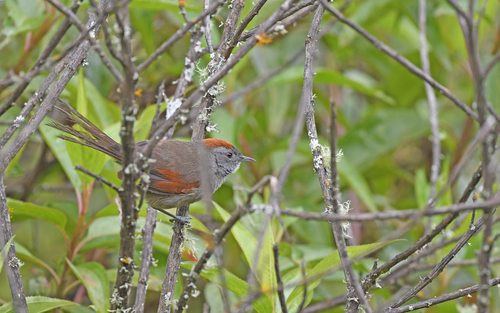
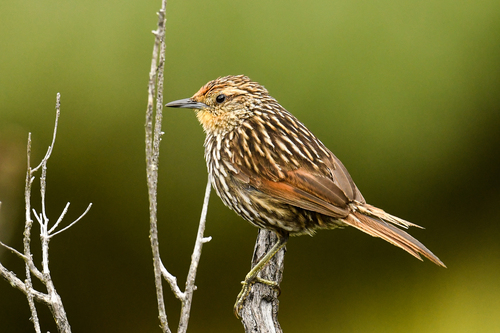
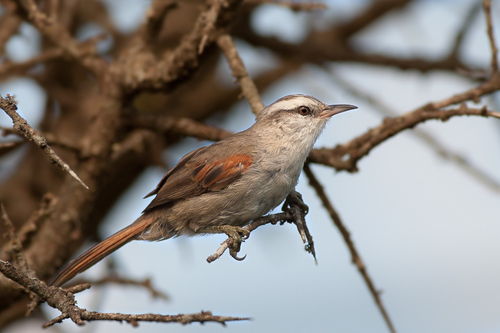
The stripe-crowned spinetail, scientifically named Cranioleuca pyrrhophia (Vieillot, 1818), is 13 to 16 cm (5.1 to 6.3 in) long and weighs 10 to 16 g (0.35 to 0.56 oz). It is a smallish member of the genus Cranioleuca, with unique crown and tail patterns. The species shows considerable plumage variation that follows Gloger's rule, and males and females have identical plumage. Adults of the nominate subspecies have a wide white supercilium, dark brown lores, dark brown coloring behind the eye, and ear coverts mixed with whitish and brown. Their crown has distinct dramatic stripes of blackish and buffy brown; these stripes are fainter in populations from southern Brazil and Paraguay. Their hindcrown and back are grayish brown, with a browner shade in southern Bolivia. Their rump and uppertail coverts are browner than their back. Their tail feathers are graduated and very pointed, creating a forked appearance. The central pair of tail feathers are dark brown or rufous with dark brown inner webs; the next two pairs are rufous with dark brown along the shafts and at the tip; and the outer pair is entirely rufous. Their wing coverts are rufous, their primary coverts dark brown, and their flight feathers dull brownish. Their throat is whitish, their breast brownish gray or buffish gray, and their belly a darker gray. The breast and belly are paler in southern Bolivia. Their iris ranges from dark red to pale orange to dark brown; their maxilla is black to gray; their mandible is pinkish horn to pinkish with a dark tip; and their legs and feet are olive-green to greenish gray or yellowish brown. Juveniles have an unstriped crown and darker underparts than adults, with faint mottling or scaling on the underparts. Subspecies C. p. striaticeps has more streaking on the crown than the nominate subspecies, along with a slightly browner back, deeper rufous uppertail coverts and central tail feathers, a paler and less gray breast and belly, and a rufescent tinge on the undertail coverts. Subspecies C. p. rufipennis has crown striping that is intermediate between the nominate subspecies and striaticeps, an even browner back than striaticeps, and more rufous on some flight feathers than the other two subspecies. The nominate subspecies of the stripe-crowned spinetail is the most widespread by far, and it is the southernmost representative of the genus Cranioleuca. It occurs in lowland southern Bolivia, western Paraguay, northeastern and central Argentina as far south as Río Negro Province, almost all of Uruguay, and Brazil's southernmost state of Rio Grande do Sul. C. p. rufipennis is found in the Andes of the Bolivian departments of La Paz and Cochabamba. C. p. striaticeps is found in the central and southern Andes of Bolivia, in the departments of Cochabamba, Santa Cruz, and Tarija. The stripe-crowned spinetail lives in a range of landscapes, including tropical deciduous forest, gallery forest, arid montane scrublands, dry savanna, semi-humid woodlands, and Alnus and Podocarpus woodlands in the Andes. It occurs at elevations ranging from near sea level to 3,100 m (10,200 ft).