About Cranioleuca erythrops (P.L.Sclater, 1860)
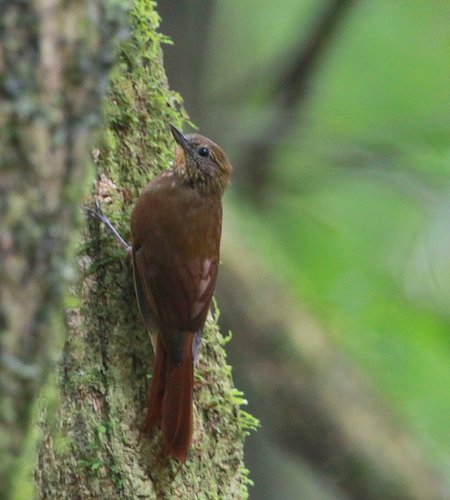
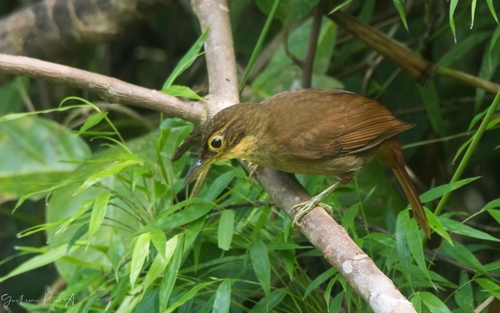
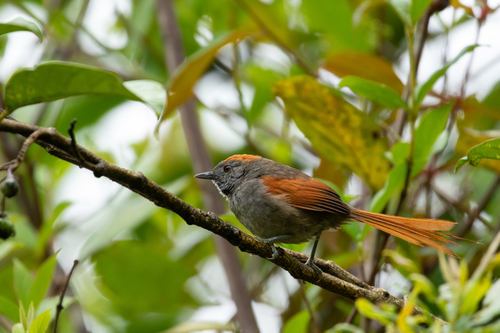
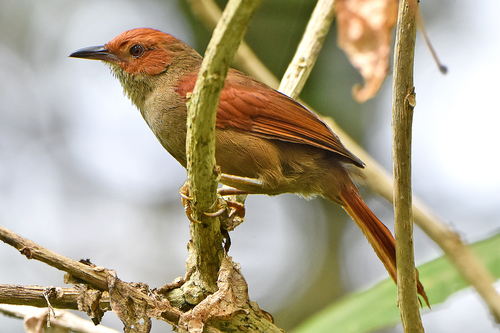
The red-faced spinetail, Cranioleuca erythrops, is 14 to 15 cm (5.5 to 5.9 in) long and weighs 13 to 20 g (0.46 to 0.71 oz). Males and females have identical plumage. Adults of the nominate subspecies have a rufous face and crown. Their nape and back are rich olive-brown, with a richer, brighter shade on the rump and uppertail coverts. Their wings are rufous; their flight feathers have slightly duller edges and dark fuscous tips. Their tail is reddish chestnut, has a graduated shape, and the feather tips lack barbs, giving the tail a spiny appearance. Their chin is brownish gray, and the rest of their underparts are dull olivaceous brown. Their iris ranges from orange to reddish brown to brown, their maxilla is blackish to dark fuscous, their mandible is grayish horn or pinkish with a blackish tip, and their legs and feet are brownish olive to greenish gray. Juveniles have an olive-brown crown, dull rufous edges on the wing coverts, an ochraceous wash on the throat and breast, and sometimes a narrow buff supercilium. Subspecies C. e. griseigularis has a brighter, more cinnamon tone to its central tail feathers and a grayer breast than the nominate. In the southern part of this subspecies' range, individuals have a grayer breast, darker crown, and less reddish back than more northerly individuals of the same subspecies. Subspecies C. e. rufigenis has more extensive rufous on the face than the nominate, and entirely rufous central tail feathers. Three subspecies of red-faced spinetail are distributed across Central and South America, from Costa Rica to southwestern Ecuador. The northernmost subspecies, C. e. rufigenis, lives in the mountains of Costa Rica and western Panama. Subspecies C. e. griseigularis is found in extreme eastern Panama, the Western Andes of Colombia as far south as Nariño Department, the west slope of Colombia's Central Andes as far south as Quindío Department, and the Serranía de San Lucas in northern Colombia. The nominate subspecies occurs in the Andes of western Ecuador south to Azuay Province, and in the coastal Cordillera de Mache. The species mostly inhabits lower to mid-elevation subtropical montane forest and woodlands, including mature secondary forest. In coastal Ecuador, it occurs locally in tropical and deciduous forest. Its elevation range varies by location: it occurs between 700 and 2,000 m (2,300 and 6,600 ft) in Costa Rica, between 1,200 and 2,300 m (3,900 and 7,500 ft) in Panama, between 800 and 2,000 m (2,600 and 6,600 ft) in Colombia, and mostly between 700 and 1,500 m (2,300 and 4,900 ft) in Ecuador, where it occurs almost to sea level in the Cordillera de Mache.