About Crambus hamella Thunberg, 1788
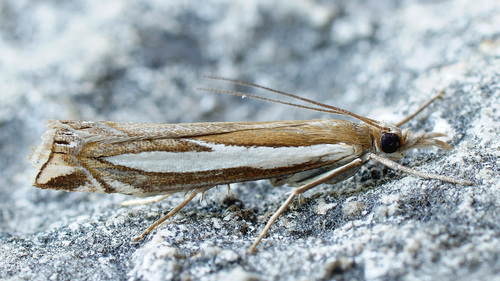
Crambus hamella is a species of moth in the family Crambidae, described by Carl Peter Thunberg in 1788. This species is distributed across most of Europe, excluding the Iberian Peninsula and most of the Balkan Peninsula. Its range extends eastward to the Russian Far East (Amur and Sakhalin) and Japan, and it also occurs in North America, where it has been recorded in Alberta, Arizona, Manitoba, Michigan, Oklahoma, and Ontario. The wingspan of adult Crambus hamella ranges from 18 to 23 mm. The forewings have a slightly elongated apex; they are brown, with whitish sprinkling across the posterior area, and white suffusion on the terminal area. A broad, pointed, snow-white median longitudinal streak runs from the base of the forewing, and does not reach the second line. The lower edge of this streak has a projection at its middle. The second line is angled, silvery-white, and has a dark edge along its anterior side. There is a triangular white subapical spot, several black longitudinal marks on the terminal area, and metallic cilia. The hindwings are grey. Additional information can be found in Parsons et al. Adults are on wing from July to August, with one generation produced per year. The larvae feed on grasses, and Deschampsia flexuosa is a possibly recorded host.