About Crambe maritima L.
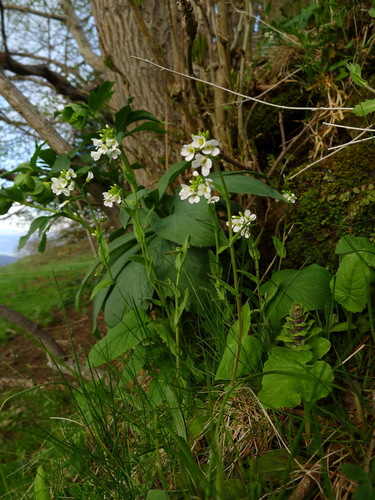
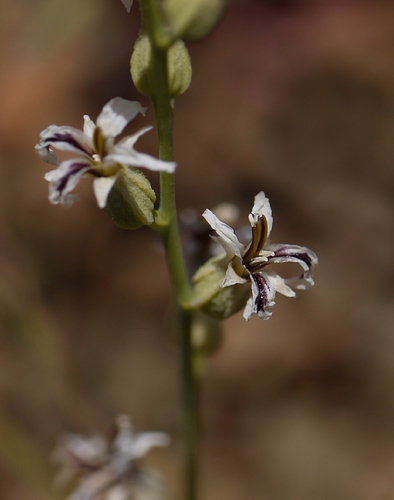
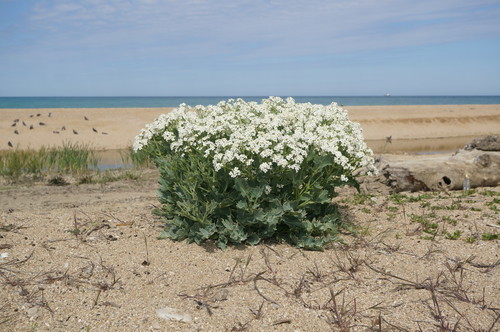
Crambe maritima L., commonly known as sea kale, is a mound-forming spreading perennial that grows to 75 cm (30 in) tall and 60 cm (24 in) wide. It produces large, fleshy, glaucous leaves similar in appearance to collard greens, abundant white flowers, and globular seed pods that each contain a single seed. This species is a European endemic, with a natural distribution restricted to two separate coastal regions of Europe, and it does not occur naturally in North Africa or the Middle East. It grows along the Black Sea coasts of Bulgaria, Romania, Turkey, and Ukraine, including the Crimea. It is absent from most of the Mediterranean, and reappears along the coast from northern France and the British Isles to the Baltic Sea. It is not found in Portugal, Greece, Italy, or Spain; in these areas and the Iberian Peninsula, it is replaced by the closely related species Crambe hispanica, and the two species were not distinguished from each other until recently. Crambe maritima is known to occur in Croatia. While populations historically reported from Israel, Jordan, Lebanon, and Syria were once classified as Crambe maritima, these are now classified as C. hispanica. Within the British Isles, Crambe maritima is very rare in Northern Ireland, but has been recorded in Counties Down and Antrim, and also in several other coastal counties on the island of Ireland. In England, it occurs primarily on the southeast coast, and grows extensively along Chesil Beach in Dorset; it can also be found along stretches of the East Anglian and Cumbrian coasts. In Wales, it grows on northern beaches, and in Scotland it is found in the extreme southwest. It is an uncommon species along the coast of Norway, and is particularly recorded in Færder National Park. Crambe maritima is a halophyte, meaning it is tolerant of salt, so it grows on coastal beaches where few other plants can thrive. It is usually found above the high tide mark on beaches where sand is mixed with pebbles or rock. A typical habitat for this species in Britain is vegetated shingle beaches, where it grows alongside yellow horned poppy and curled dock. On fragmentary, endangered shingle beach and bar habitats along the southern Baltic coasts of Sweden, Finland, Estonia, and extending east to Mecklenburg, Crambe maritima is the dominant plant species of local plant communities. In these habitats, it grows alongside Leymus arenarius, Euphorbia palustris, Honkenya peploides, Angelica archangelica subsp. litoralis, Atriplex spp., Beta vulgaris subsp. maritima, Elymus repens, Geranium robertianum subsp. rubricaule, Glaucium flavum, Isatis tinctoria, Ligusticum scoticum, Mertensia maritima, Silene uniflora, Tripleurospermum maritimum, and Valeriana salina. Clumps of sea kale can trap wind-blown sand, and may contribute to the initial formation of dunes. Sea kale has a history of cultivation and culinary use dating back to the 18th century. There are 18th century records of local people along the beaches of Kent, Sussex, and Hampshire harvesting newly emerging shoots from naturally occurring root crowns in early spring to use as a vegetable. This custom was first documented by Phillip Miller in his 1731 Gardener's Dictionary, where he noted it was practiced by people in Sussex; in 1753, sea kale shoots were recorded being sold as food at Chichester market. John Martyn was the first to publish practical cultivation notes in a later edition of Miller's work, while William Curtis was the first to publish a tract about his experiments growing sea kale as a vegetable crop in London in 1799, shortly before his death. In 1805, John Maher presented a talk before the Horticultural Society of London that expanded slightly on Curtis' work. Both Curtis and Maher recommended growing sea kale as a forced, blanched vegetable. Root crowns are placed in a ceramic cylinder capped with a closed blanching pot, and fresh manure is heaped a few feet deep over the pot. The heat from the decomposing manure forces the plant to produce shoots as early as December, though forcing later in the winter was recommended. For people who could not afford expensive blanching pots, Maher suggested covering plants with a mat topped with a thick layer of gravel. Curtis noted that a foot of soil could be hoed over the crown, or sea sand, pebbles, or coal ash piled over it, but both authors agreed that these alternative methods produce a much lower quality crop. A roughly five square foot area can hold one root crown made up of three plants. After growing from seed for three years, the plants can be forced at least twice per season to yield four to six shoots that can reach up to twelve inches long, though yields are usually smaller. Thomas Jefferson grew sea kale at Monticello between 1820 and 1825. It was served at the Royal Pavilion in Brighton when George IV, then Prince Regent, used the pavilion as a seaside retreat. By the Victorian Era, sea kale was in very general use as a vegetable in Britain according to Mrs Beeton's Book of Household Management, which referred to it as a type of asparagus. At nine pennies for a basket of sprouts, it was one of the most expensive vegetables available at the time. Its cultivation is discussed in older books on vegetable growing. Wild populations of sea kale in Britain were severely reduced by in situ forcing and wild harvesting for food, until the practice was banned in the early 20th century. Sea kale fell out of common culinary use, but in the early 21st century, British chefs brought it back into fashion. It is now commercially grown by a number of farmers in Britain. A small experimental plot of sea kale is cultivated on Texel, a North Sea island in the Netherlands, where the crop is irrigated with diluted seawater. Maher personally considered blanched sea kale to be a delicacy. Curtis wrote that when boiled for twenty minutes and served with melted butter, the flavor is most similar to asparagus, with slight notes of cabbage. He reported that most people who tried it found it pleasant; while some thought it was no better than cabbage, others considered it superior to asparagus. Although Curtis never tested these preparations himself, he noted that one person had made a decent stew with sea kale, and he theorized that it could be suitable for pickling.