About Cotula pruinosa (DC.) Jakoet & Magee
Cotula pruinosa (DC.) Jakoet & Magee is an annual herb, 60–520 mm in height, and does not root at the nodes. The stems are usually erect to decumbent, 15–270 mm long, and sparsely hairy. The leaves are alternate, with lengths decreasing towards the upper part of the plant. They are 2 - or 3 - pinnatisect, 25–65 × 5–30 mm, obovate to oblanceolate, green to dark green, and usually have a petiole - like base. The leaf lobes are linear, 1–4 × 0.5–1.0 mm, ± terete, becoming smaller towards the leaf base, sparsely hairy, with acute apices.
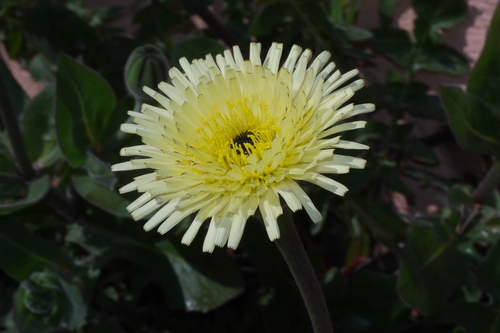
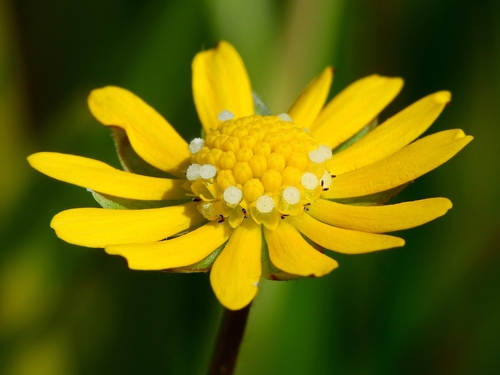
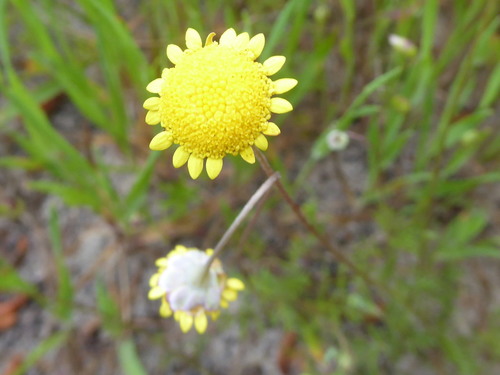
The capitula are heterogamous, 5–20 mm in diameter, disciform, pseudo - radiate, with a convex disc face, solitary, terminal, and pedunculate. The peduncles are 14–85 mm long, apically swollen in fruit; the swelling is obconical, 3–20 × 2–10 mm, dark green, and hollow. The involucre is hemispherical; the bracts are 2 - or 3 - seriate, broadly ovate, 1.5–4.0 × 0.5–5.0 mm, with an obtuse apex, glabrous, green, opaque, and the apex and margins are scarious and brownish, 3 - to 5 - veined. The receptacle is shallowly convex.
Filiform florets are female, in a single outermost series, pedicellate, and lack a corolla. The ovary is elliptic to slightly obovate, broadly winged, slightly concave on the ventral surface, and glandular. The pedicels of filiform florets are 0.5 mm at maturity. Disc florets are bisexual, heteromorphic, pedicellate, and 4 - lobed. The lobes are mostly triangular, ca. 0.4 mm long. Florets in the outermost series have a greatly enlarged dorsal lobe resembling a ray limb, about twice the length of the other three lobes, obtuse to elliptic, ca. 2.0–3.5 mm long. The tube does not basally drape over the ovary. The limbs are bell - to cup - shaped and yellow. The pedicels of disc florets are 0.1–0.3 mm long, gradually decreasing in length towards the center.
The cypselae are heteromorphic. Those of filiform florets are ovoid, 1.4–2.4 × 1.2–1.8 mm, broadly winged, with the wing about ⅓ times the width of the female portion, slightly concave on the outer surface, and have sessile glands. Those of disc florets are ovoid, 1.2–1.7 × 0.7–1.0 mm, with prominent marginal ribs and sessile glands. There is a band of myxogenic cells on the ventral surface flanking the fertile portion, and resin canals are absent.
Diagnostically, Cotula pruinosa was once considered a yellow - flowered variety of Cotula turbinata. It is distinguished by the cypselae of disc florets, which have conspicuous bands of myxogenic cells flanking the fertile portion on the ventral surface. It shares this cypsela trait with Cotula duckittiae but can be differentiated by its yellow (not orange) pseudo - ray florets with the dorsal lobe only two times the length of the other three lobes (almost four times in C. duckittiae) and a convex disc face (concave to flat in C. duckittiae). Cenia expansa, previously a synonym of C. duckittiae, is now treated as conspecific with C. pruinosa. Although they seem different, there is significant overlap and intermediates where they co - occur.
Cotula pruinosa is the most widespread in the group, found from Clanwilliam to Struisbaai in the Western Cape Province. It prefers deep coastal sands and the base of rocky outcrops. The soils are sandier and less disturbed than those in C. turbinata habitats. It can also invade sandy road verges. Flowering is usually from late winter to mid - spring (August–October) but can continue into summer (December–February) in some conditions. Additional specimen details include various collection locations in the Western Cape, with specific dates and collectors noted.