About Cotoneaster integerrimus Medik.
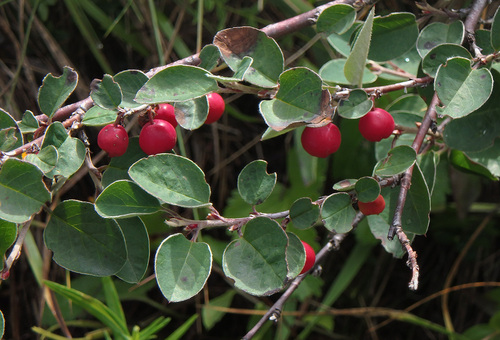
Cotoneaster integerrimus Medik., commonly called common cotoneaster, is a species of the Cotoneaster genus. It is native to central and eastern Europe, as well as southwest Asia. Its native range extends from southern Belgium and eastern France south to Italy, and east through Germany to the Balkans, northern Turkey, the Crimea, the Caucasus, and northern Iran. Plants growing in Spain may also belong to this species. In the past, this species was treated with a broader definition that included plants from Wales that are now split off as the separate species Cotoneaster cambricus, and plants from Scandinavia now recognized as the separate species Cotoneaster scandinavicus. Cotoneaster integerrimus differs from both of these species in its genetic profile, and in detailed characteristics of its foliage and fruit. This is a deciduous shrub that grows up to 2 metres (6 ft 7 in) tall. Its leaves are shaped oval to oval-acute, and measure 1–4 centimetres (0.39–1.57 in) long. When young, the upper leaf surface is green and thinly covered with fine soft hairs, and becomes hairless as it matures. The lower leaf surface and leaf margin are densely covered in fine pale grey hairs. In mid spring, the plant produces flowers in corymbs holding 1 to 4 flowers, occasionally up to seven flowers together. Each flower is 3 millimetres (0.12 in) in diameter, with five white to pale pink petals. The fruit is a dark red pome 6–8 millimetres (0.24–0.31 in) in diameter, which contains two or three seeds, with an average of 2.8 seeds per fruit. Fruits of this species have an average water content of 85.3%. This plant grows on limestone soils, at altitudes up to 2,800 metres (9,200 ft).