About Cosmosalia chrysocoma (Kirby, 1837)
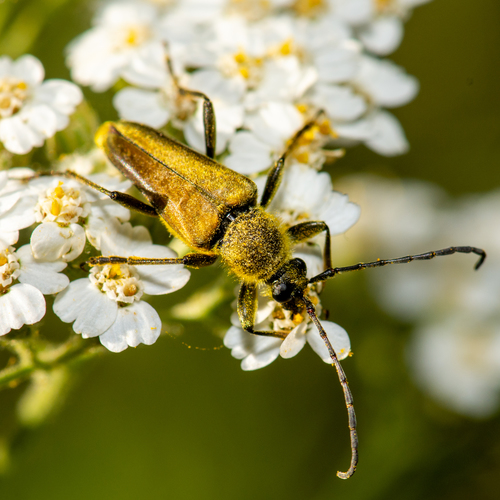
Lepturobosca chrysocoma is a species of longhorn beetle in the family Cerambycidae. It was first formally described as Cosmosalia chrysocoma by William Kirby in 1837. In 1998, Russian entomologist Alexander Ivanovich Miroshnikov compared what was then called Cosmosalia chrysocoma with Lepturobosca virens, leading to the genera Cosmosalia and Lepturobosca being grouped together under the single genus name Lepturobosca. Common names for this species include the yellow velvet beetle, golden flower longhorn beetle, and golden-haired flower longhorn. Within Canada, this beetle has been recorded in British Columbia, Alberta, Saskatchewan, Manitoba, Ontario, Quebec, New Brunswick, Nova Scotia, Newfoundland, Prince Edward Island, the Northwest Territories, and the Yukon Territory. In the United States, it has been found in Montana and Wyoming. Adults of this species are between 10 and 20 millimetres (0.39 to 0.79 inches) long, and their bodies are covered in a dense coat of golden hairs. Adult beetles are commonly observed feeding on flowers during the summer. Their dense hairy coat catches pollen, which they carry and transfer to other flowers while they feed, facilitating pollination. The larvae of this beetle feed on decaying tree wood, including the decaying wood of Picea mariana and species of Populus. This species is a documented host for Coleocentrus quebecensis, a species of parasitic wasp belonging to the subfamily Acaenitinae.