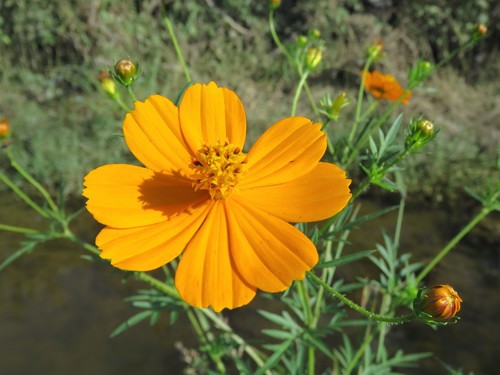
About Cosmos sulphureus Cav.
Cosmos sulphureus Cav. is a half-hardy annual species of Cosmos, though individual plants may re-appear for several years through self-sowing. It has opposite, pinnately divided foliage, and reaches a height between 1 and 7 feet (30 to 210 cm). Both the original species and its cultivars have flower shades of yellow, orange, and red. The species is especially popular in Korea and Japan, where it is commonly grown in mass plantings along roadsides as part of an initiative led by Korean-Japanese botanist Woo Jang-choon.
For cultivation, the species has the following growth characteristics: germination occurs in 7 to 21 days at an optimal temperature of 75 degrees Fahrenheit, and flowering starts 50 to 60 days after germination. It prefers soil with a pH between 6.0 and 8.5, which matches its native habitat in the alkaline regions of Central America. It produces the best flowering in full sun, though it can tolerate partial shade. After germination, it is drought-tolerant and is rarely damaged by insects or disease; this strong growth has led to it being classified as a pest in some areas of the United States.
For uses, young shoots of this plant are eaten raw or cooked in Indonesia, where it is known as lalab or gudang. Its flowers produce an orange-yellow dye, which was used in pre-Columbian America and later in southern Africa to dye wool. In Thailand, the flowers are eaten in salads or made into herbal tea, and are reported to have an inhibitory effect on pancreatic lipase. A 2017 study by a Pakistani research team found that plant extract had a hepatoprotective effect in rats given a high dose of paracetamol. A 2017 Ukrainian publication gave high organoleptic ratings to bread made with 10% dry extract of Cosmos sulphureus.