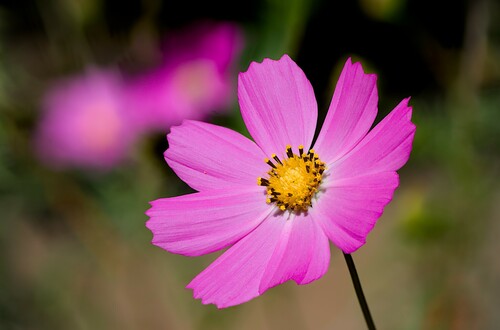
About Cosmos bipinnatus Cav.
Cosmos bipinnatus Cav. is an annual plant often classified as half-hardy, though it may reappear for several years through self-sowing. Plant height typically ranges from 2 to 6 feet (0.61 to 1.83 meters), and rarely reaches up to 9 feet (2.74 meters). Cultivated varieties come in shades of pink, purple, and white. The branched stem is usually densely to occasionally covered in fine, divided, rough trichomes, but some individual plants are completely hairless. The petiole is inconspicuous, winged, and usually 10 mm long, rarely reaching 15 mm; sometimes leaves are almost sessile. Segmented leaves are linear-filiform to narrow linear, measuring 0.5 to 1 mm wide, and rarely up to 1.7 mm wide; their tips are pointed and hardened, but not particularly sharp. The overall foliage looks finely cut into threadlike segments. When flowering, plants can become top-heavy, but this issue is reduced when grown in groups, because the bipinnate leaves interlock and the plants support each other. Its achenes turn blackish, and are either smooth or covered in short bristles. Achenes are spindle-shaped, tapering to a short, 0.5 to 1.7 mm long, but distinctly defined rostrum. Inner achenes are up to 18 mm long, with yellowish beaks that are 4 to 5 mm long, and rarely up to 10 mm long. A pappus is either absent, or consists only of two to three awn-like bristles 1 to 3 mm long. According to Plants of the World Online, this species is native to Mexico. However, other sources record it as native to the United States and Canada. Because it is grown as an ornamental plant in many countries and spreads easily, it is an invasive plant in many areas of the world. It has naturalized in scattered locations across North America, South America, the West Indies, Italy, Australia, and Asia, where it occurs as a garden escape, that is, an introduced species, and becomes a weed in some habitats. For cultivation, germination takes between 7 and 10 days at the optimal temperature of 75 °F (24 °C), and flowering begins between 60 and 90 days after germination. This plant prefers soil with a pH between 6.0 and 8.5, which matches its native habitat in the alkaline regions of Central America. Flowering is best in full sun, though it can tolerate partial shade. Excessive rain can cause problems in cultivation, due to the delicate nature of the stems, and heavy rain can cause stems to break. Cosmos bipinnatus can tolerate heat as long as enough moisture is provided, but it does not tolerate droughts, strong winds, or cold temperatures well. Snails, slugs, and aphids feed on Cosmos bipinnatus. Successfully cultivated plants can reach a mature size of 2 to 4 feet (0.61 to 1.22 m) tall by 12 to 18 inches (300 to 460 mm) wide. They cannot tolerate frost, but can be grown outdoors in temperate climates with warm to hot summers, so they are called half-hardy in British gardening literature.