About Cosmos atrosanguineus (Hook.) Voss
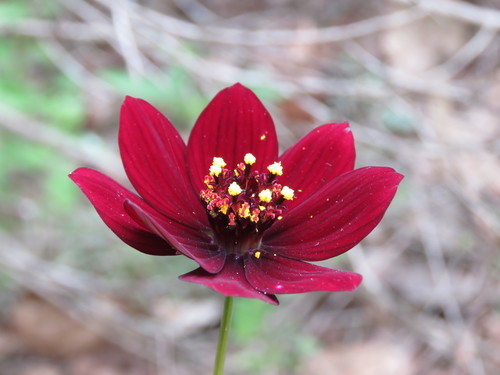
Cosmos atrosanguineus is a herbaceous perennial plant that reaches 40–60 cm in height, and has a fleshy tuberous root. Its leaves are 7–15 cm long and pinnate, with leaflets that are 2–5 cm long. Flowers grow in capitula 3–4.5 cm in diameter, with colors ranging from dark red to maroon-dark brown. Each flower head has a ring of six to ten (usually eight) broad ray florets surrounding a center of disc florets. The flowers carry a light vanillin fragrance similar to the scent of chocolate, and this fragrance becomes more noticeable toward the end of the day.
Previously, Cosmos atrosanguineus was reported to be extinct in the wild. However, a 2007 research project on the genus Cosmos led by Mexican botanist Aarón Rodríguez uncovered modern records of the species dating back to 1986. Field work confirmed the species grows in the Mexican states of Guanajuato, Querétaro, and San Luis Potosí. It inhabits mixed pine and oak forests at elevations between roughly 1,800–2,450 m (5,910–8,040 ft).
Both seed-raised and vegetatively propagated cultivars of this species are available commercially, and these cultivars differ in petal size, color, and shape. A 2017 article documented 17 cultivars and seed-raised strains. As of 2018, the cultivar C. atrosanguineus 'Hamcoec', sold under the trade name Eclipse, produces the largest flower heads, which can reach up to 5 cm in diameter. Variation in flower color (from red to black) across the species and its cultivars is caused by differing amounts of anthocyanins and chalcone. Hybrids between this species and other Cosmos species are also known in cultivation. Like the hybrid Cosmos 'Thomocha' (marketed as Chocamocha), these hybrids are often less strongly scented than the pure species. Despite its chocolate-like scent, Cosmos atrosanguineus is not edible. This plant grows best with partial or full sun, and flowers from mid to late summer. It is sensitive to frost, suitable for USDA Zones 6–11. In temperate regions, the tubers must be dug up and stored in a frost-free location over the winter.