About Cosmophasis lami Berry, Beatty & Prószyński, 1997
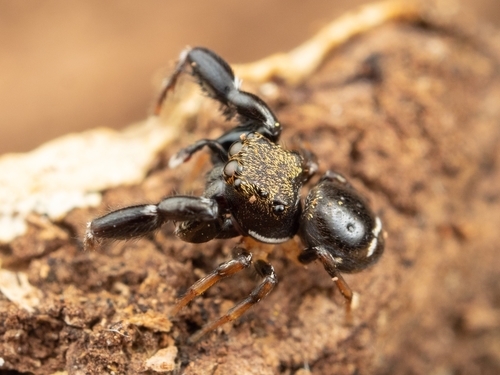
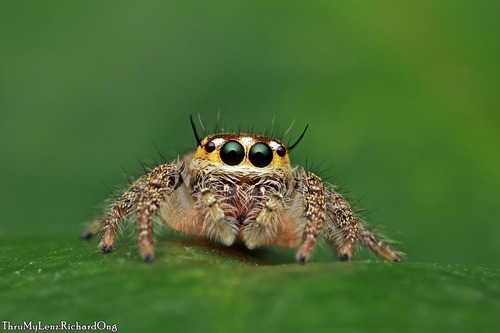
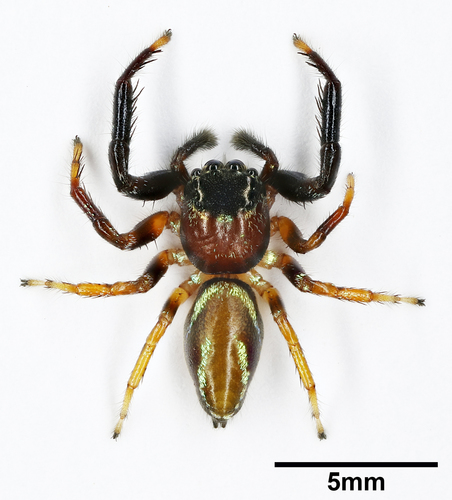
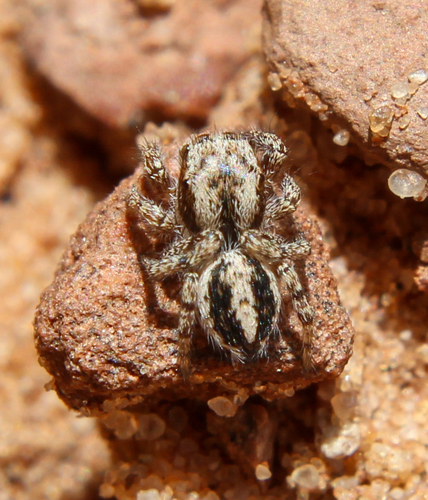
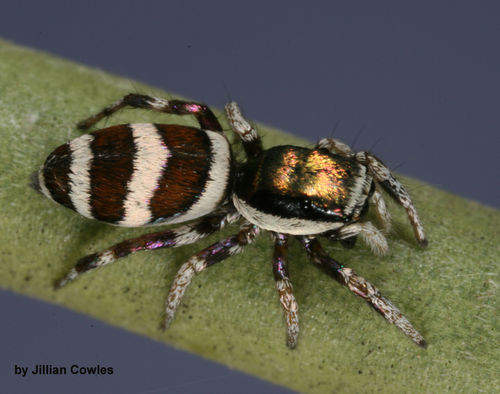
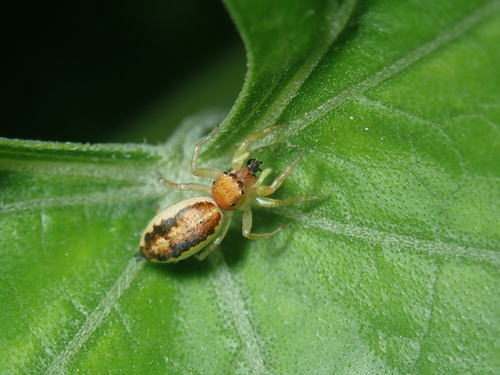
This species, Cosmophasis lami, shows sexual dimorphism, though exact physical descriptions can vary between individuals, and females typically have more vibrant coloration than males. For adult Cosmophasis lami, the carapace is orange-brown, with a dark-brown area surrounding the eyes, and is covered in orange hairs; the clypeus is also orange-brown. Males are covered in orange hairs, have dull orange cephalothoraxes, a slender orange abdomen, an orange-brown clypeus, a black apex and black spinnerets, and a dark-brown area around the eyes. Females are almost identical to males, differing only by having a grayish brown sternum and distinct abdominal markings. Cosmophasis lami is similar to the related species Cosmophasis hortoni, but is smaller, has shorter chelicerae, and has a longer embolus on the male palp that extends southeast from the bulb. An iridescent morph of this species exists. It is considered the most widely distributed species in the genus Cosmophasis. It was first observed in Fiji, and is native to South East Asia, the Philippines, the Cocos Islands, Mauritius, and the Marquesas Islands. According to the World Spider Catalog, it has been introduced to Seychelles, the Marquesas Islands, the Society Islands, Fiji, and Hawaii. It was first recorded in Japan in 2013 by Tatsumi Suguro. Eight years after that, in 2021, specimens were recorded on Okinawa Island, found on roadside vegetation in a residential area, and this occurrence is thought to be the result of artificial introduction. Specimens were also recorded in Taiwan in 2021. Little is known about the ecology of Cosmophasis lami, but it is confirmed to be a peridomestic carnivorous arthropod predator. One study found that males do not show stereotypical behavior when fighting with other males. Common behaviors observed in males include vertical "pumping" movements of the pedipalps and continuous vertical movement of the abdomen.