About Coscoroba coscoroba (Molina, 1782)
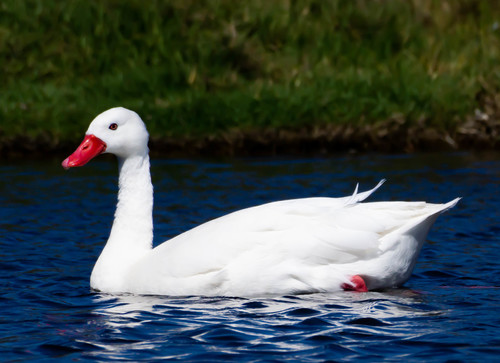
The coscoroba swan (Coscoroba coscoroba) is a medium-large waterfowl species, smaller than true swans. It measures 90 to 115 cm (35 to 45 in) in length, with an approximate wingspan of 155 cm (61 in). Males weigh 3.8 to 5.4 kg (8.4 to 12 lb), while females weigh 3.1 to 4.5 kg (6.8 to 9.9 lb). Its appearance is considered slightly unusual, as it is intermediate between geese and true swans. Unlike true swans, its entire face is covered in feathers. Its feet are positioned directly under its body, which lets it walk far more efficiently than the waddling gait of most other waterfowl. Physically, the coscoroba swan is compared to the American Pekin duck, though it is larger, and has darker, redder bills and feet—American Pekin ducks have bright orange bills and feet instead. Males and females have identical plumage. When newly hatched, coscoroba swan chicks have blue-grey bills and feet, with black striping along the full length of their bodies that helps camouflage them from predators. This patterning fades completely by around eight months of age. Adult coscoroba swans are entirely white, except for black tips on the six outermost primary feathers. This black marking is usually barely visible when the wing is closed, and is only obvious when the bird is in flight. Coscoroba swans remain year-round residents in central Argentina, and along the coast of Uruguay to southern Brazil. They breed, but do not overwinter, in southern Chile and southern Argentina extending south to Tierra del Fuego, and occasionally reach the Falkland Islands for breeding. In winter, the species' range expands north to central Chile, northern Argentina, Paraguay, Uruguay, and southern Brazil. It has been recorded as a vagrant in Bolivia and in multiple locations in Brazil north of its typical range. The coscoroba swan lives in well-vegetated lagoons, freshwater swamps, and sometimes man-made reservoirs. It is primarily a lowland species, though scattered records exist from elevations as high as 1,300 m (4,300 ft), and at least one record exists from 2,000 m (6,600 ft).