About Corythopis delalandi (Lesson, 1831)
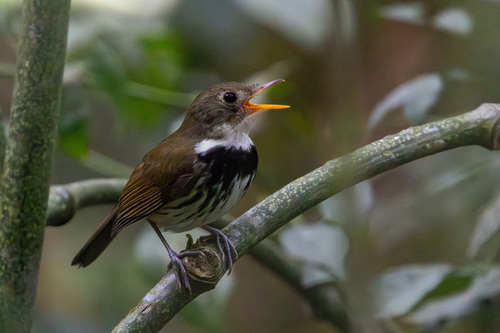
The southern antpipit, scientifically named Corythopis delalandi (Lesson, 1831), measures 13 to 14 cm (5.1 to 5.5 in) in length and weighs 14 to 18 g (0.49 to 0.63 oz). Males and females have identical plumage. Adult individuals have a grayish olive crown, a faint whitish loral spot, and a faint whitish spot behind the eye; the rest of their face is pale grayish olive. Their upperparts, wings, and tail are olive. Their chin and throat are creamy white. Most of their underparts are white, with an almost solid black "necklace" across the breast, and black streaks extend from this necklace along the flanks. The flanks also have a grayish olive wash. Juveniles look identical to adults. Both sexes have a medium to dark brown iris, a blackish upper mandible, a pale pinkish lower mandible with a yellow to pinkish orange base, and long pale grayish pink legs. This species is a bird native to the southern Atlantic Forest. It occurs in the Santa Cruz and Tarija departments of eastern Bolivia, the Salta, Misiones, and Corrientes provinces of northern Argentina, eastern Paraguay, and southern Brazil. In southern Brazil, its range extends northeast from the bordering countries to southern Maranhão, east to Minas Gerais, and south to northwestern Rio Grande do Sul. The southern antpipit lives in tropical lowland forest, including both primary and secondary forest. It can be found at elevations ranging from sea level to 1,000 m (3,300 ft), though most individuals live below 800 m (2,600 ft).