About Coryphospingus cucullatus (P.L.S.Müller, 1776)
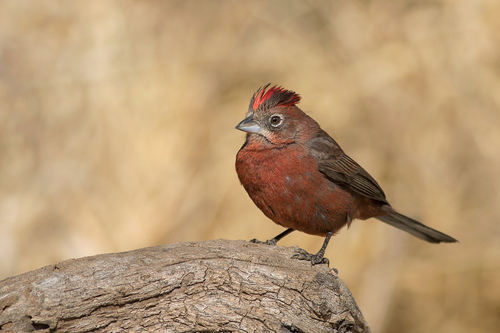
The red pileated finch (Coryphospingus cucullatus) is approximately 13.5 cm (5.3 in) long. Both males and females of this species have a white eye ring. Males have a red crest and a black crown, which matches the features of the grey pileated finch. Unlike the grey pileated finch, male red pileated finches have dark wine-red upperparts, a reddish rump, and drab reddish underparts. Females lack the red crest and black head that males have, and their upperparts are slightly more brown than those of males. Female red pileated finches also have a white throat and pink underparts. This species has a wide distribution across South America. Its main continuous range covers southern Brazil and northern Argentina, stretching south from Brasília and Rio de Janeiro to Buenos Aires, and west to the Andean foothills. In addition to this main range, several isolated populations exist: in dry mountain valleys of Ecuador, Peru, and Bolivia; one separate population in northern Brazil; and another in Suriname, Guyana, and French Guiana. The red pileated finch is rarely found at elevations above 1,500 m (4,900 ft), but in the Cusco region of southeastern Peru, it can occur up to around 2,000 m (6,600 ft).