About Coryphistera alaudina Burmeister, 1860
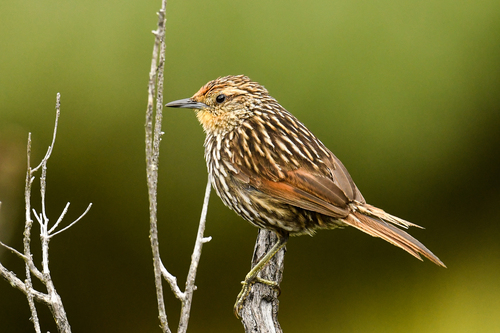
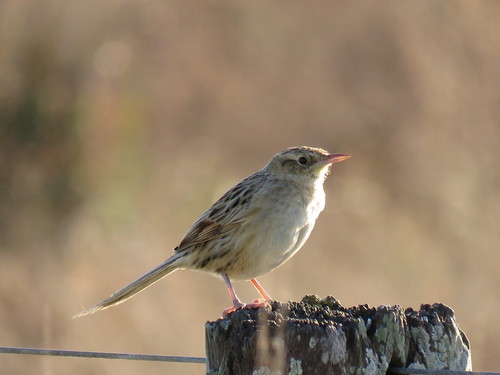
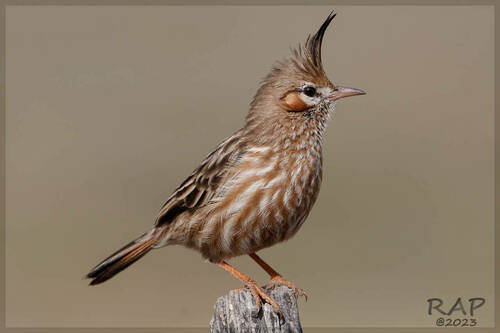
The lark-like brushrunner (Coryphistera alaudina Burmeister, 1860) measures 15 to 17 cm (5.9 to 6.7 in) long and weighs 27 to 42 g (0.95 to 1.5 oz). It is an unusual furnariid that, as its common name suggests, resembles a lark, with an erect crest. The two sexes have identical plumage.
Adults of the nominate subspecies have white plumage around the eye that extends onto the ear coverts, which are otherwise cinnamon-rufous. Their lores are dull brownish. Their forehead is rufescent brownish, and their crown and crest are very dark brown. Their back is pale dull brown, with vague darker streaks on the upper section that become wider and darker on the lower back, rump, and uppertail coverts. Their crown has narrow blackish streaks that almost disappear on the hindneck and upper back, then become longer and wider on the lower back. Their wing coverts are dark fuscous brown, primary coverts are blackish, and flight feathers are blackish with rufescent inner edges and pale buff outer edges. The central pair of their tail feathers are dark fuscous brown with buff edges; the remaining tail feathers are mostly rufous, with progressively less dark fuscous brown on their edges toward the outermost feathers. Their chin and throat are whitish, with dull rufous streaks on the throat. Their breast is whitish with wide blurry rufous streaks that fade and become browner on the upper belly, flanks, and undertail coverts; the center of the belly is mostly unstreaked. Their iris is dark brown to light grayish brown. Their maxilla is brownish to pinkish brown, usually with a darker tip. Their mandible is pinkish gray to yellow-brown, sometimes with a darker tip. Their legs and feet are dull orange to grayish tan to light brown. Juveniles have a shorter crest and less distinct streaks than adults.
Subspecies C. a. campicola has pale rufous edges at the base of the crest feathers, more buff edging on the feathers of the upperparts, and paler streaks on the underparts than the nominate subspecies.
The nominate subspecies is the more widespread of the two. It occurs in southern Bolivia, northern and eastern Argentina, northwestern Uruguay, and extends slightly into the southernmost Brazilian state of Rio Grande do Sul. Subspecies C. a. campicola occurs in southeastern Bolivia and western Paraguay.
This species lives in open to semi-open landscapes, including arid lowland scrublands, arid Gran Chaco woodlands, savanna, and pastures with trees. It also occurs in agricultural fields, though to a lesser extent. It ranges in elevation from near sea level to 500 m (1,600 ft).