About Coryphantha robustispina (A.Schott ex Engelm.) Britton & Rose
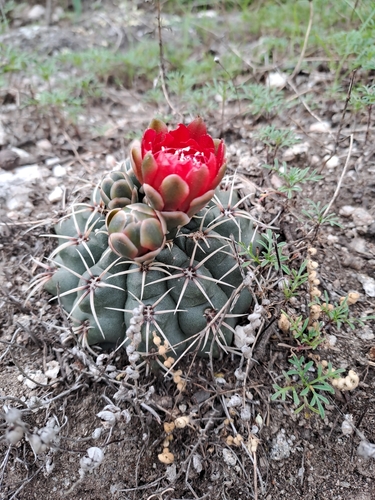
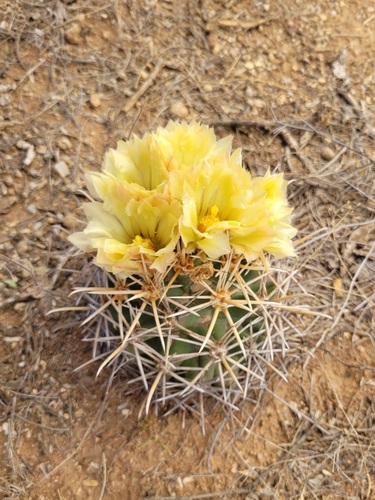
Coryphantha robustispina most often grows solitarily in an ovoid shape. Its body is a clean greyish-green color, reaching 5–9 cm tall and 5–15 cm in diameter, though larger individual plants are commonly found. Its areoles are oval or cylindrical with a deep furrow, and have one or two nectar glands. It produces 1 to 4 central spines that are either curved or hooked; these spines are white or grey with darker tips, and measure 1 to 5 cm in length. It also has 6 to 16 off-white radial spines, which grow between 1 and 3 cm long. The species' flowers are golden yellow, pale green, or opaque yellow. Its seed pods are cylindrical, green, and can grow up to 5 cm long. This cactus is rare, found in Arizona, New Mexico, and Texas in the United States, as well as in the Mexican states of Chihuahua and Sonora. Coryphantha robustispina var. robustispina is listed on the United States Federal Endangered Species list under its former scientific name, Coryphantha scheeri var. robustispina. Coryphantha robustispina has a complex life cycle. First, it flowers after monsoon rain, most often in July. A specific type of bee fertilizes the flowers a couple of days later, as the flowers only last for a short time. Next, the mature seed pods are frequently eaten by jackrabbits. The seeds pass through the jackrabbit's intestines, and are deposited on the ground in the animal's feces. The feces protect the seeds until a specific type of termite consumes them, which triggers the seeds to germinate and grow into new plants. This process does not occur with cottontail rabbits, as their teeth damage the seeds. This full life cycle is extremely complex, and the plant cannot reproduce successfully if any single step is interrupted. While this is the typical natural life cycle for the species, seeds collected directly from fruits that have not passed through the intestines of a jackrabbit or other animal can have a high germination rate, and can be grown successfully into mature plants.